Economics of the Roman Stone Trade
0
0
As an Amazon Associate and affiliate partner, Menrva Books earns from qualifying purchases. Learn more
Author Description
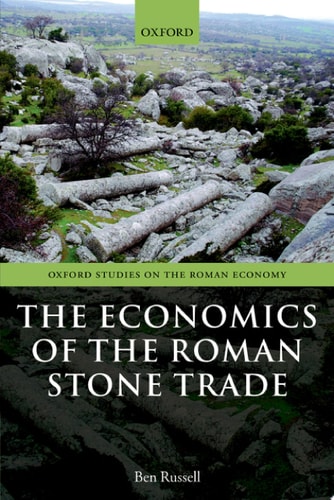
This Innovative Monograph Series Reflects A Vigorous Revival Of Interest In The Ancient Economy, Focusing On The Mediterranean World Under Roman Rule (c.100 Bc To Ad 350). Carefully Quantified Archaeological And Documentary Data Will Be Integrated To Help Ancient Historians, Economic Historians, And Archaeologists Think About Economic Behaviour Collectively Rather Than From Separate Perspectives. The Volumes Will Include A Substantial Comparative Element And Thus Be Of Interest To Historians Of Other Periods And Places. The Use Of Stone In Vast Quantities Is A Ubiquitous And Defining Feature Of The Material Culture Of The Roman World. In This Volume, Russell Provides A New And Wide-ranging Examination Of The Production, Distribution, And Use Of Carved Stone Objects Throughout The Roman World, Including How Enormous Quantities Of High-quality White And Polychrome Marbles Were Moved All Around The Mediterranean To Meet The Demand For Exotic Material. The Long-distance Supply Of Materials For Artistic And Architectural Production, Not To Mention The Trade In Finished Objects Like Statues And Sarcophagi, Is One Of The Most Remarkable Features Of The Roman World. Despite This, It Has Never Received Much Attention In Mainstream Economic Studies. Focusing On The Market For Stone And Its Supply, The Administration, Distribution, And Chronology Of Quarrying, And The Practicalities Of Stone Transport, Russell Offers A Detailed Assessment Of The Roman Stone Trade And How The Relationship Between Producer And Customer Functioned Even Over Considerable Distances.
Menrva's Summary
THE THESIS
How did the Roman Empire sustain the massive, long-distance trade of stone and marble that defined its architectural and artistic landscape? Ben Russell, an expert in Roman material culture, utilizes a synthesis of archaeological evidence and documentary records to reconstruct the economic mechanics of the stone industry. He argues that the trade in raw and finished stone was a sophisticated, market-driven system that bridged the gap between distant quarries and urban centers, challenging the historical neglect of this sector in broader economic studies.
THE SCOPE MAP
What You Will Find
- Analysis of the production, distribution, and consumption of white and polychrome marbles.
- Examination of the administrative and logistical frameworks governing quarrying operations.
- Assessment of the transport infrastructure required for moving heavy stone objects across the Mediterranean.
- Case studies on the relationship between producers and customers in the Roman economy.
Scope Limits
- The study is geographically focused on the Mediterranean world under Roman rule.
- The chronological scope is limited to the period between 100 BC and AD 350.
THE AUTHORITY PERSPECTIVE
Scholars in the field of ancient history and archaeology identify this work as a significant contribution to the study of Roman economic behavior. Readers frequently note the technical density of the research, which successfully integrates material culture with economic theory to provide a comprehensive view of the stone trade.
Page Count:
480
Publication Date:
2013-01-01
Publisher:
Oxford University Press
ISBN-10:
0191630403
ISBN-13:
9780191630408
Economics
History
Stone carving
Roman Empire
Archaeology
Community Tags
Other Editions(2)

Similar Books