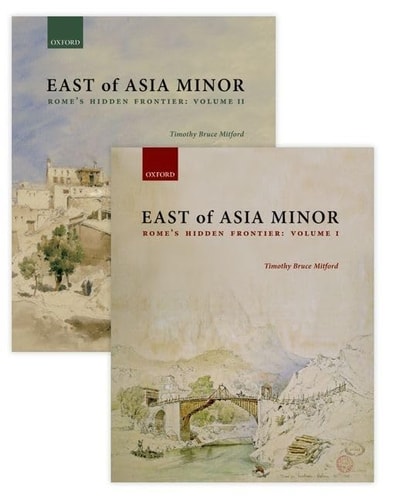
East of Asia Minor: Rome's Hidden Frontier
0
0
As an Amazon Associate and affiliate partner, Menrva Books earns from qualifying purchases. Learn more
Author Description
The North-eastern Frontier Of The Roman Empire - One Of The Great Gaps In Modern Knowledge Of The Ancient World - Has Long Eluded Research. It Has Defied Systematic Exploration And Been Insulated Against All But Passing Survey By Wars, Instability, Political Sensitivities, Language, And The Region's Wild, Remote Mountains, Mostly Accessible Only On Horseback Or On Foot. Its Path Lay Across Eastern Turkey, Following The Euphrates Valley Northwards From Syria, Through Gorges And Across Great Ranges, And Passing Over The Pontic Alps To Reach The Further Shores Of The Black Sea. Vespasian Established Rome's Frontier Against Armenia Half A Century Before Hadrian's Wall. Five Times As Long, And Climbing Seven Times As High, It Was Garrisoned Ultimately By Four Legions And A Large Auxiliary Army, Stationed In Intermediate Forts Linked By Military Roads. The Two Volumes Of 'east Of Asia Minor: Rome's Hidden Frontier' - Based On Research, Field Work Conducted Largely On Foot, And New Discoveries - Document The Topography, Monuments, Inscriptions, And Sighted Coins Of The Frontier, Looking In Detail At Strategic Roads, Bridges, Forts, Watch And Signalling Systems, And Navigation Of The Euphrates Itself. Study Of The Terrain Provides A Foundation For Interpreting The Literary And Epigraphic Evidence For The Frontier And Its Garrisons. Military Activity, Which Extended To The Caucasus And The Caspian, Is Placed In The Context Of Climate, Geography, And Inter-regional Trade Routes.
Menrva's Summary
THE THESIS
This work investigates the topography, military infrastructure, and strategic significance of the Roman Empire's northeastern frontier, a region historically obscured by geographic and political barriers. Timothy Bruce Mitford, a scholar specializing in the Roman East, synthesizes decades of field research conducted on foot across eastern Turkey. By integrating archaeological findings—including inscriptions, coins, and structural remains—with classical literary sources, the author constructs a comprehensive framework for understanding how Rome projected power against Armenia and the Caucasus.
THE SCOPE MAP
What You Will Find
- Detailed analysis of the Roman frontier line extending from the Euphrates Valley to the Black Sea.
- Documentation of military infrastructure including forts, watchtowers, signaling systems, and road networks.
- Examination of the logistical challenges posed by the Pontic Alps and the Euphrates river system.
- Synthesis of epigraphic and numismatic evidence to reconstruct garrison placement and troop movements.
THE AUTHORITY PERSPECTIVE
Experts recognize this work as a foundational study for the Roman frontier in the East, particularly for its rigorous field-based methodology. Readers frequently note the academic density of the prose and the depth of the topographical analysis provided by the author.
Page Count:
757
Publication Date:
2018-01-01
Publisher:
Oxford University Press,
ISBN-10:
0198148747
ISBN-13:
9780198148746
History
Roman Empire
Grenze
Military History
Boundaries
Grenzgebiet
Ancient History
Ostprovinzen
Archaeology
Romans
Community Tags
Other Editions(2)
Similar Books