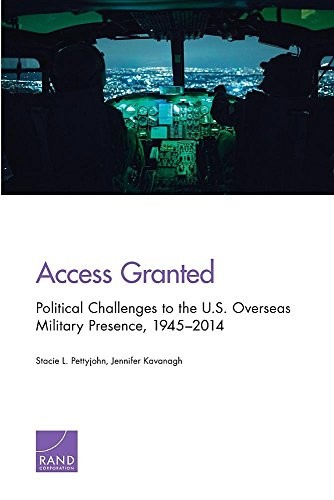
Access Granted
0
0
As an Amazon Associate and affiliate partner, Menrva Books earns from qualifying purchases. Learn more
Author Description
While the U.S. military depends on access to overseas bases to project military power around the globe both in peacetime and during contingencies, it has faced a variety of political challenges to this access. This report aims to fill a gap in the existing literature on this topic through a comprehensive and empirical analysis of the challenges the United States has confronted since 1945. The authors examine the kinds and severity of access problems the United States has faced and how these have changed over time and suggest how the United States can counter political threats to access. The authors find that, while political challenges to access have occurred regularly, the threat has often been overstated. Moreover, the United States faces two separate access problems: challenges to its peacetime base rights and difficulties securing contingency access permissions. Peacetime and contingency access are linked, but not in the way that many assume. Access to large permanent bases during peacetime does not increase the probability that the United States will be granted permission to use a facility during a crisis. Instead, only enduring partners — nations in which there is an elite security consensus in support of the U.S. presence — offer more reliable access during peacetime and in contingencies.
Menrva's Summary
THE THESIS
The U.S. military's reliance on overseas bases for global power projection is consistently challenged by political obstacles. This report provides a comprehensive, empirical analysis of the political challenges to U.S. access to overseas bases since 1945, addressing a gap in existing literature. The authors investigate the nature and severity of these access problems, their evolution over time, and propose strategies for the U.S. to counter political threats. Their findings indicate that while political challenges are regular, the overall threat has often been exaggerated, and that the U.S. faces distinct issues concerning peacetime base rights versus contingency access permissions.
THE SCOPE MAP
- Analysis of political challenges to U.S. overseas base access from 1945 to the present.
- Empirical examination of the kinds and severity of access problems encountered.
- Investigation into how access challenges have changed over time.
- Strategies for countering political threats to military access.
- Distinction between peacetime base rights and contingency access permissions.
- Identification of 'enduring partners' as key to reliable access.
- Argument that peacetime access does not directly correlate with contingency access.
THE AUTHORITY PERSPECTIVE
This report is recognized for its empirical and comprehensive analysis of a critical aspect of U.S. foreign policy and military strategy. The authors' distinction between peacetime and contingency access, and their identification of 'enduring partners' as crucial for reliable access, offer a nuanced perspective on geopolitical realities. The study's findings suggest that while challenges exist, the threat to U.S. access has often been overstated, providing a grounded assessment for policymakers and academics.
Page Count:
236
Publication Date:
2017-01-01
ISBN-10:
0833094599
ISBN-13:
9780833094599
Science
History
Politics
Non-Fiction
Military History
Geopolitics
International relations
Community Tags
Similar Books