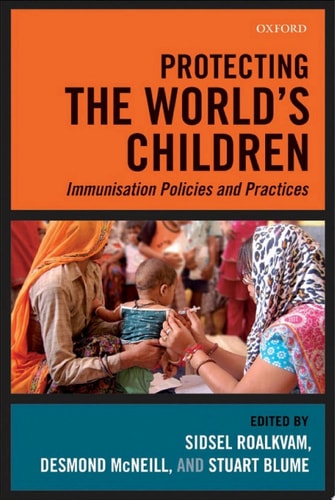
Protecting the World's Children: Immunisation Policies and Practices
0
0
As an Amazon Associate and affiliate partner, Menrva Books earns from qualifying purchases. Learn more
Author Description
Vaccination programmes now represent a major part of the effort devoted to improving the health of children in developing countries. These donor-funded programmes tend to be global in scope and focus on worldwide goals and targets such as 'polio eradication', and the Millennium Development Goals. Health policy makers at the national level are expected to implement these programmes in a standard manner and report progress according to a few standard indicators. Pressures and incentives to achieve the targets set are then transmitted down to the community level health worker who actually meets the parents and children to implement the programmes. Drawing on first hand, original research in India and Malawi carried out by the contributors, as well as existing literature, Protecting the World's Children: Immunisation policies and practices suggests that there is little or no scope allowed for the effects of variance in the way health systems work, the difficulties and tensions faced by health workers, or differences in the way people think about childhood illnesses that reflect cultural differences. The book argues that the need to show progress can create distortions and lead to the production of misleading data and an unwillingness to report problems. It proposes that vaccines could more effectively serve children's health needs if immunisation programmes are better understood and acknowledged, and if local knowledge and realities were enabled to inform national and international health policy. Written by an international, interdisciplinary team of experts in immunisation policy, Protecting the World's Children is an integrative study of immunisation policy and practice at a global, national and community level, and is an essential resource for researchers and practitioners in international and public health, as well as professionals in international and development studies.
Menrva's Summary
THE THESIS
This book investigates the disconnect between top-down global immunization targets and the complex, localized realities of health delivery in developing nations. The authors, an interdisciplinary team of experts, utilize original field research from India and Malawi to argue that standardized, donor-driven health policies often ignore cultural nuances and systemic constraints. By examining the pressure to meet quantitative indicators, the text demonstrates how current frameworks can inadvertently incentivize data distortion and hinder effective health outcomes.
THE SCOPE MAP
What You Will Find
- Comparative analysis of immunization policy implementation in India and Malawi
- Examination of the tension between global health targets and local health worker experiences
- Critique of standardized reporting indicators in international development
- Proposals for integrating local knowledge into national and international health policy
Scope Limits
- The study focuses primarily on the intersection of policy and practice rather than the clinical efficacy of specific vaccines
- It does not provide a comprehensive global survey of every national immunization program
THE AUTHORITY PERSPECTIVE
Experts in public health and development studies recognize this work as a critical examination of the limitations inherent in top-down global health initiatives. Readers frequently note the academic rigor of the research and the text's utility for practitioners seeking to understand the socio-political barriers to effective health policy implementation.
Page Count:
248
Publication Date:
2013-01-01
Publisher:
OUP Oxford
ISBN-10:
019164451X
ISBN-13:
9780191644511
Public Health
Health Policy
Global Health
Sociology of Medicine
Medical
Epidemiology
Allied Health
International Development
Community Tags
Similar Books