Illustrating the Phaenomena: Celestial Cartography in Antiquity and the Middle Ages
0
0
As an Amazon Associate and affiliate partner, Menrva Books earns from qualifying purchases. Learn more
Author Description
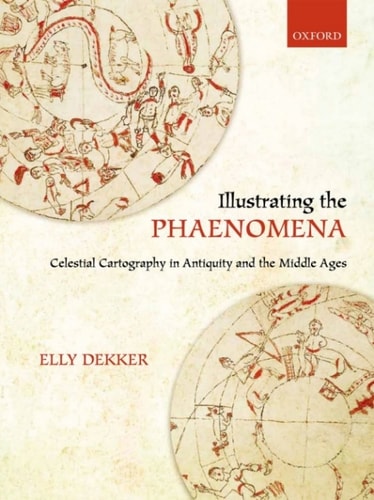
The introduction of the moving sphere as a model for understanding the celestial phenomena caused a great breakthrough in scientific thinking about the structure of the world. It provided the momentum for making celestial globes and mapping the stars. Celestial globes were produced first by Greek astronomers, and soon became greatly appreciated in antiquity as decorative objects (3 antique globes). The design and construction of the globe varied greatly as it passed through the Arabic (10 scientific globes made before 1500) and Medieval European cultures (3 scientific globes made before 1500). It was the starting-point for the design of many maps in antiquity and later in the Middle Ages (33) serving to illustrate books such as Aratus's Phaenomena. In the early fifteenth century scientific celestial maps (5) were constructed in their own right, independent of globes. In this book all extant celestial maps and globes made before 1500 are described and analysed in detail. This prestigious study will appeal to academic historians of science and astronomy, and art historians alike.
Menrva's Summary
THE THESIS
This work investigates the evolution of celestial cartography and the development of the moving sphere as a foundational model for understanding the structure of the cosmos from antiquity through the Middle Ages. Elly Dekker, a scholar specializing in the history of scientific instruments, utilizes a comprehensive catalog of extant artifacts to argue that the transition from globes to independent celestial maps represents a critical shift in scientific methodology. By examining the technical construction and cultural adaptation of these objects, the author demonstrates how celestial representation evolved from decorative antiquity to precise scientific documentation.
THE SCOPE MAP
What You Will Find
- A detailed analysis of all extant celestial maps and globes produced before 1500.
- Comparative studies of Greek, Arabic, and Medieval European design methodologies.
- Examination of the relationship between celestial globes and the illustration of literary texts like Aratus's Phaenomena.
- Documentation of the transition from globe-dependent mapping to independent celestial cartography in the early fifteenth century.
Scope Limits
- The study is strictly limited to celestial artifacts created prior to the year 1500.
- It does not cover terrestrial cartography or post-Renaissance astronomical developments.
THE AUTHORITY PERSPECTIVE
Experts recognize this volume as a definitive reference for the study of pre-modern scientific instruments and the history of astronomy. Scholars frequently cite the work for its rigorous cataloging and technical analysis of surviving artifacts.
Page Count:
467
Publication Date:
2012-01-01
Publisher:
OUP Oxford
ISBN-10:
0191642193
ISBN-13:
9780191642197
History
Art History
Astronomy
Earth Sciences
Ancient History
Science History
Stars atlases
Cartography