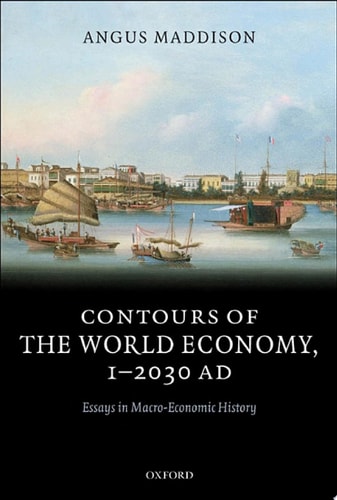
Contours of the World Economy 1-2030 AD: Essays in Macro-Economic History
0
0
As an Amazon Associate and affiliate partner, Menrva Books earns from qualifying purchases. Learn more
Author Description
This book seeks to identify the forces which explain how and why some parts of the world have grown rich and others have lagged behind. Encompassing 2000 years of history, part 1 begins with the Roman Empire and explores the key factors that have influenced economic development in Africa, Asia, the Americas and Europe. Part 2 covers the development of macroeconomic tools of analysis from the 17th century to the present. Part 3 looks to the future and considers what the shape of the world economy might be in 2030. Combining both the close quantitative analysis for which Professor Maddison is famous with a more qualitative approach that takes into account the complexity of the forces at work, this book provides students and all interested readers with a totally fascinating overview of world economic history. Professor Maddison has the unique ability to synthesise vast amounts of information into a clear narrative flow that entertains as well as informs, making this text an invaluable resource for all students and scholars, and anyone interested in trying to understand why some parts of the World are so much richer than others.
Menrva's Summary
THE THESIS
This work investigates the historical determinants of global economic divergence and the mechanisms that have allowed specific regions to achieve prosperity while others remain underdeveloped. Angus Maddison, a renowned economic historian, utilizes long-term quantitative data to construct a framework for understanding economic growth over two millennia. By integrating historical analysis with macroeconomic theory, he examines the interplay between institutional development, technological advancement, and resource distribution across diverse geographical regions.
THE SCOPE MAP
What You Will Find
- Quantitative analysis of global GDP and economic performance from 1 AD to 2030 AD
- Historical examination of economic development in Africa, Asia, the Americas, and Europe
- A survey of the evolution of macroeconomic analytical tools from the 17th century onward
- Projections and considerations regarding the future trajectory of the global economy
Scope Limits
- The text does not provide granular microeconomic analysis of specific local markets or individual firm behaviors
- It does not offer a comprehensive political history of the regions discussed, focusing primarily on economic outcomes
THE AUTHORITY PERSPECTIVE
Experts recognize this text as a foundational resource for understanding long-term global economic trends through a quantitative lens. Readers frequently note the clarity of Maddison's synthesis, which makes complex historical data accessible to both students and professional scholars.
Page Count:
427
Publication Date:
2007-01-01
Publisher:
OUP Oxford
ISBN-10:
0191647586
ISBN-13:
9780191647581
Economics
Economics history
Economic History
Macroeconomics
Global History