
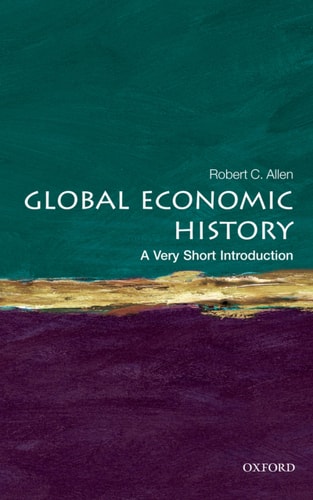
Global Economic History: A Very Short Introduction
0
0
As an Amazon Associate and affiliate partner, Menrva Books earns from qualifying purchases. Learn more
Author Description
Why are some countries rich and others poor? In 1500, the income differences were small, but they have grown dramatically since Columbus reached America. Since then, the interplay between geography, globalization, technological change, and economic policy has determined the wealth and poverty of nations. The industrial revolution was Britain's path breaking response to the challenge of globalization. Western Europe and North America joined Britain to form a club of rich nations by pursuing four polices-creating a national market by abolishing internal tariffs and investing in transportation, erecting an external tariff to protect their fledgling industries from British competition, banks to stabilize the currency and mobilize domestic savings for investment, and mass education to prepare people for industrial work. Together these countries pioneered new technologies that have made them ever richer. Before the Industrial Revolution, most of the world's manufacturing was done in Asia, but industries from Casablanca to Canton were destroyed by western competition in the nineteenth century, and Asia was transformed into 'underdeveloped countries' specializing in agriculture. The spread of economic development has been slow since modern technology was invented to fit the needs of rich countries and is ill adapted to the economic and geographical conditions of poor countries. A few countries - Japan, Soviet Russia, South Korea, Taiwan, and perhaps China - have, nonetheless, caught up with the West through creative responses to the technological challenge and with Big Push industrialization that has achieved rapid growth through investment coordination. Whether other countries can emulate the success of East Asia is a challenge for the future. ABOUT THE SERIES: The Very Short Introductions series from Oxford University Press contains hundreds of titles in almost every subject area. These pocket-sized books are the perfect way to get ahead in a new subject quickly.
Menrva's Summary
THE THESIS
This book investigates the historical divergence in wealth between nations, specifically examining why income disparities have widened so dramatically since 1500. Robert C. Allen, a professor of economic history, utilizes a comparative framework to analyze how geography, globalization, technological innovation, and specific economic policies have shaped the prosperity of different regions. He argues that the industrial success of Western nations was not inevitable but rather the result of specific, replicable policy choices and responses to global market conditions.
THE SCOPE MAP
What You Will Find
- Analysis of the Industrial Revolution and its role in global economic divergence.
- Examination of the four-pillar policy model used by Western nations to achieve wealth.
- Comparative studies of economic development in Asia, Europe, and North America.
- Discussion of the 'Big Push' industrialization strategy.
Scope Limits
- The text provides a high-level overview rather than an exhaustive data-driven analysis of every individual nation.
- It focuses primarily on macro-economic trends rather than micro-economic or cultural nuances.
THE AUTHORITY PERSPECTIVE
Experts and readers recognize this work as a concise, accessible entry point into the complex field of global economic history. The prose is noted for its clarity and ability to distill dense historical data into a coherent narrative for non-specialist audiences.
Page Count:
193
Publication Date:
2011-01-01
Publisher:
OUP Oxford
ISBN-10:
019162053X
ISBN-13:
9780191620539
Economics
Economics history
Global History
Economic History
Community Tags
Other Editions(2)
Similar Books





Reader Comments
Share Your Thoughts
No comments yet. Be the first to share your thoughts!