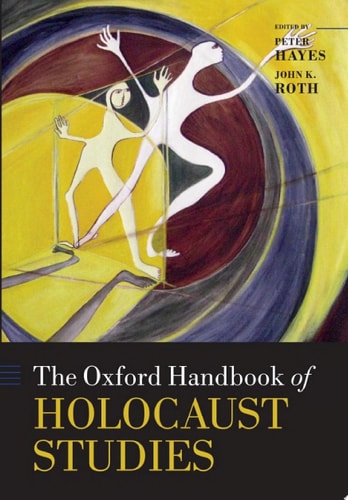
The Oxford Handbook of Holocaust Studies
0
0
As an Amazon Associate and affiliate partner, Menrva Books earns from qualifying purchases. Learn more
Author Description
Few scholarly fields have developed in recent decades as rapidly and vigorously as Holocaust Studies. At the start of the twenty-first century, the persecution and murder perpetrated by the Nazi regime have become the subjects of an enormous literature in multiple academic disciplines and a touchstone of public and intellectual discourse in such diverse fields as politics, ethics and religion. Forward-looking and multi-disciplinary, this handbook draws on the work of an international team of forty-seven outstanding scholars. The handbook is thematically divided into five broad sections. Part One, Enablers, concentrates on the broad and necessary contextual conditions for the Holocaust. Part Two, Protagonists, concentrates on the principal persons and groups involved in the Holocaust and attempts to disaggregate the conventional interpretive categories of perpetrator, victim, and bystander. It examines the agency of the Nazi leaders and killers and of those involved in resisting and surviving the assault. Part Three, Settings, concentrates on the particular places, sites, and physical circumstances where the actions of the Holocaust's protagonists and the forms of persecution were literally grounded. Part Four, Representations, engages complex questions about how the Holocaust can and should be grasped and what meaning or lack of meaning might be attributed to events through historical analysis, interpretation of texts, artistic creation and criticism, and philosophical and religious reflection. Part Five, Aftereffects, explores the Holocaust's impact on politics and ethics, education and religion, national identities and international relations, the prospects for genocide prevention, and the defense of human rights.
Menrva's Summary
THE THESIS
This handbook investigates the multifaceted historical, ethical, and political dimensions of the Holocaust by synthesizing diverse academic perspectives into a unified analytical framework. Editors John K. Roth and Peter Hayes curate contributions from forty-seven international scholars to examine the event not merely as a historical occurrence, but as a complex phenomenon with enduring global implications. The text utilizes a multi-disciplinary approach to dissect the conditions, participants, and long-term societal consequences of the Nazi regime's actions.
THE SCOPE MAP
What You Will Find
- Analysis of the contextual conditions and enablers of the Holocaust
- Disaggregation of traditional categories including perpetrators, victims, and bystanders
- Examination of geographical settings and physical sites of persecution
- Exploration of artistic, philosophical, and religious representations of the event
- Assessment of the Holocaust's impact on international relations and human rights
Scope Limits
- Does not provide a singular, unified narrative history of the war
- Excludes exhaustive primary source documentation in favor of thematic synthesis
THE AUTHORITY PERSPECTIVE
Experts recognize this volume as a comprehensive reference work that successfully bridges the gap between specialized historical research and broader intellectual discourse. Readers frequently note the academic density of the prose, which serves as a standard resource for scholars and advanced students in the field.
Page Count:
780
Publication Date:
2012-01-01
Publisher:
OUP Oxford
ISBN-10:
019165079X
ISBN-13:
9780191650796
Religion
History
Judaism
Jewish History
Military History
Ethics
Community Tags
Other Editions(3)
Similar Books
Reader Comments
Share Your Thoughts
No comments yet. Be the first to share your thoughts!