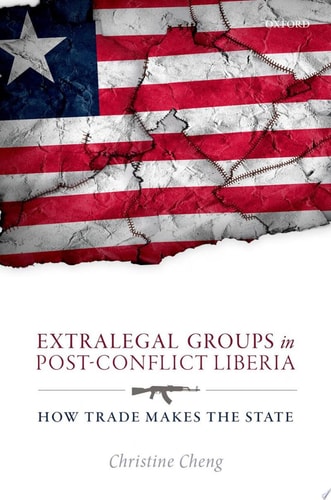
Extralegal Groups in Post-conflict Liberia
0
0
As an Amazon Associate and affiliate partner, Menrva Books earns from qualifying purchases. Learn more
Author Description
In The Aftermath Of The Liberian Civil War, Groups Of Ex-combatants Seized Control Of Natural Resource Enclaves In The Rubber, Diamond, And Timber Sectors. With Some Of Them Threatening A Return To War, These Groups Were Widely Viewed As The Most Significant Threats To Liberia's Hard-won Peace. Building On Fieldwork And Socio-historical Analysis, This Book Shows How Extralegal Groups Are Driven To Provide Basic Governance Goods In Their Bid To Create A Stable Commercial Environment. This Is A Story About How Their Livelihood Strategies Merged With The Opportunities Of Liberia's Post-war Political Economy. But It Is Also A Context-specific Story That Is Rooted In The Country's Geography, Its History Of State-making, And Its Social And Political Practices. This Volume Demonstrates That Extralegal Groups Do Not Emerge In A Vacuum. In Areas Of Limited Statehood, Where The State Is Weak And Political Authority Is Contested, Where Rule Of Law Is Corrupted And Government Distrust Runs Deep, Extralegal Groups Can Provide Order And Dispute Resolution, Forming The Basic Kernel Of The State. This Logic Counters The Prevailing 'spoiler' Narrative, Forcing Us To Reimagine Non-state Actors And Recast Their Roles As Incidental Statebuilders In The Evolutionary Process Of State-making. This Leads To A Broader Argument: It Is Trade, Rather Than War, That Drives Contemporary Statebuilding. Along The Way, This Book Poses Some Uncomfortable Questions About What It Means To Be Legitimately Governed, Whether Our Trust In States Is Ultimately Misplaced, Whether Entrenched Corruption Is The Most Likely Post-conflict Outcome, And Whether Our Expectations Of International Peacebuilding And Statebuilding Are Ultimately Self-defeating.
Menrva's Summary
THE THESIS
This book investigates how extralegal groups in post-conflict Liberia function as incidental statebuilders by providing governance and order in areas where the state is weak or absent. Christine Cheng, a scholar of international relations and conflict, utilizes extensive fieldwork and socio-historical analysis to challenge the conventional view of these groups as mere spoilers. She argues that the pursuit of stable commercial environments for natural resource extraction drives these actors to establish systems of dispute resolution and governance, fundamentally altering our understanding of state-making processes.
THE SCOPE MAP
What You Will Find
- Analysis of post-conflict political economy in the rubber, diamond, and timber sectors.
- A framework for understanding governance in areas of limited statehood.
- Historical and geographical context of Liberian state-making practices.
Scope Limits
- The study focuses specifically on the Liberian context and may not be universally applicable to all post-conflict zones.
- The research does not provide a comprehensive policy manual for international peacebuilding interventions.
THE AUTHORITY PERSPECTIVE
Experts in political science and African studies recognize this work as a significant contribution to the study of non-state actors and the complexities of post-conflict governance. Readers frequently note the academic rigor of the prose and the author's ability to synthesize complex socio-political dynamics into a coherent, provocative argument.
Page Count:
432
Publication Date:
2018-01-01
Publisher:
Oxford University Press
ISBN-10:
0191654310
ISBN-13:
9780191654312
Sociology
International relations
Statebuilding
Conflict Resolution
Community Tags
Other Editions(2)
Similar Books