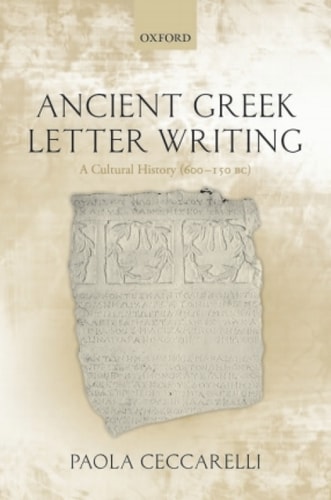
Ancient Greek Letter Writing: A Cultural History (600 BC-150 BC)
0
0
As an Amazon Associate and affiliate partner, Menrva Books earns from qualifying purchases. Learn more
Author Description
In this volume, Ceccarelli offers a history of the development of letter writing in ancient Greece from the archaic to the early Hellenistic period. Highlighting the specificity of letter-writing, as opposed to other forms of communication and writing, the volume looks at documentary letters, but also traces the role of embedded letters in the texts of the ancient historians, in drama, and in the speeches of the orators. While a letter is in itself the transcription of an oral message and, as such, can be either truthful or deceitful, letters acquired negative connotations in the fifth century, especially when used for transactions concerning the public and not the private sphere. Viewed as the instrument of tyrants or near eastern kings, these negative connotations were evident especially in Athens where comedy and tragedy testified to an underlying concern with epistolary communication. In other areas of the Greek world, such as Sparta or Crete, the letter may have been seen as an unproblematic instrument for managing public policies, with inscriptions documenting the official use of letters not only by the Hellenistic kings, but also by some poleis.
Menrva's Summary
THE THESIS
This volume investigates the evolution and cultural perception of letter writing in ancient Greece from the archaic period through the early Hellenistic era. Paola Ceccarelli, a scholar of classical antiquity, examines the transition of the letter from a simple oral transcription to a complex tool of political and social communication. By analyzing both documentary evidence and literary representations, the author argues that the letter functioned as a contested medium, oscillating between a private necessity and a suspicious instrument of power.
THE SCOPE MAP
What You Will Find
- Analysis of letters embedded within historical texts, drama, and oratory.
- Examination of the socio-political divide regarding epistolary use between Athens, Sparta, and Crete.
- Investigation into the negative connotations of letters as tools of tyranny and public deception.
Scope Limits
- The study is strictly confined to the period between 600 BC and 150 BC.
- The text focuses primarily on the Greek world and does not provide an exhaustive comparative analysis of contemporary Near Eastern epistolary traditions.
THE AUTHORITY PERSPECTIVE
Scholars recognize this work as a significant contribution to the study of ancient communication and the history of the written word. Experts highlight the text's academic rigor and its ability to synthesize diverse literary and epigraphic sources into a cohesive historical narrative.
Page Count:
464
Publication Date:
2013-01-01
Publisher:
OUP Oxford
ISBN-10:
0191663077
ISBN-13:
9780191663079
History
Communication Studies
Politics & Government
Ancient Greece
Epistolary History
Letter Writing
Power Social sciences
Ancient History
Cultural History
Community Tags
Similar Books