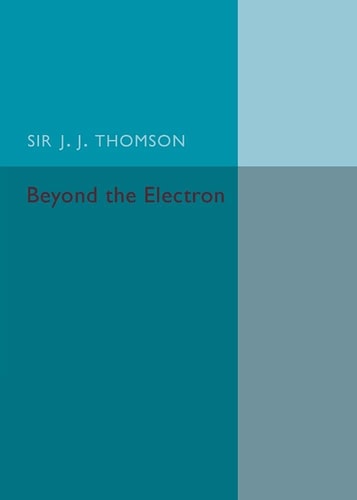
Beyond the Electron
0
0
As an Amazon Associate and affiliate partner, Menrva Books earns from qualifying purchases. Learn more
Author Description
Sir Joseph John Thomson was an English physicist and Nobel Prize winner and is credited with the discovery and identification of the electron and with the discovery of the first subatomic particle. Thomson is also credited with finding the first evidence for isotopes of a stable (non-radioactive) element in 1913, as part of his exploration into the composition of canal rays (positive ions). Originally published in 1928, this book presents the first of a series of Founders' Memorial Lectures, delivered at Girton College on March 3rd 1928. The lecture discusses, debates and deliberates the many discoveries of modern physics as well as the structure of the universe, and addresses both the professional scientific worker, but also students with a non-scientific background. This fascinating, insightful and ground breaking lecture will be of considerable value to scholars of physics as well as to anyone with an interest in the history of science.
Menrva's Summary
THE THESIS
This lecture explores the revolutionary discoveries in modern physics and the fundamental structure of the universe as understood in the early 20th century. Sir J. J. Thomson, a Nobel laureate renowned for discovering the electron, presents his insights in this Founders' Memorial Lecture. He delves into the implications of subatomic particles, the evidence for isotopes, and the nature of canal rays. The lecture is crafted to engage both seasoned scientific professionals and students with a non-scientific background, offering a valuable perspective on the evolving landscape of physics.
THE SCOPE MAP
- The discovery and identification of the electron by J. J. Thomson.
- Thomson's exploration into the composition of canal rays and the first evidence for isotopes.
- A discussion of modern physics discoveries and the structure of the universe.
- Insights from a lecture delivered at Girton College in March 1928.
- Content suitable for both scientific workers and students with non-scientific backgrounds.
THE AUTHORITY PERSPECTIVE
This lecture, originally delivered in 1928 and later published, offers a historical perspective on the foundational discoveries of modern physics. The content is presented by a preeminent figure in the field, Sir J. J. Thomson, making it a valuable resource for understanding the scientific discourse of the era. Its accessibility is noted, aiming to bridge the gap between specialized scientific knowledge and broader intellectual curiosity. The work is positioned as a significant contribution to the history of science, appealing to scholars and general readers interested in scientific progress.
Page Count:
46
Publication Date:
2016-10-06
Publisher:
Cambridge University Press
ISBN-10:
1316626148
ISBN-13:
9781316626146
Non-Fiction
Biography
Science
Physics
Community Tags
Similar Books