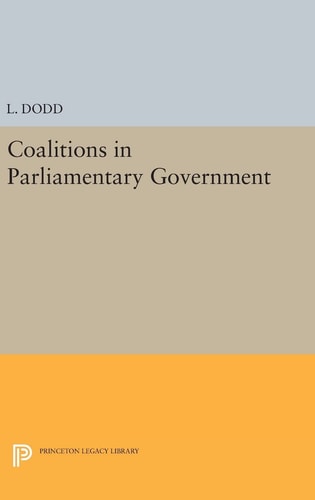
Coalitions in Parliamentary Government
0
0
As an Amazon Associate and affiliate partner, Menrva Books earns from qualifying purchases. Learn more
Author Description
For eighty years, students of parliamentary democracy have argued that durable cabinets require majority party government. Lawrence Dodd challenges this widely held belief and offers in its place a revisionist interpretation based on contemporary game theory. He argues for a fundamental alteration in existing conceptions of the relationship between party systems and parliamentary government. The author notes that cabinet durability depends on the coalitional status of the party or parties that form the cabinet. This status is created by the fractionalization, instability, and polarization that characterize the parliamentary party system. Cabinets of minimum winning status are likely to endure; as they depart from minimum winning status, their durability should decrease. Hypotheses derived from the author's theory arc examined against the experience of seventeen Western nations from 1918 to 1974. Making extensive use of quantitative analysis, the author compares behavioral patterns in multiparty and majority party parliaments, contrasts interwar and postwar parliaments, and examines the consistency of key behavioral patterns according to country. He concludes that a key to durable government is the minimum winning status of the cabinet, which may be attained in multiparty or majority party parliaments. Originally published in 1976. The Princeton Legacy Library uses the latest print-on-demand technology to again make available previously out-of-print books from the distinguished backlist of Princeton University Press. These editions preserve the original texts of these important books while presenting them in durable paperback and hardcover editions. The goal of the Princeton Legacy Library is to vastly increase access to the rich scholarly heritage found in the thousands of books published by Princeton University Press since its founding in 1905.
Menrva's Summary
THE THESIS
This book investigates whether durable cabinets in parliamentary democracies fundamentally require majority party government, challenging the long-held belief that majority rule is the sole determinant of cabinet stability. Lawrence Dodd presents a revisionist interpretation, utilizing contemporary game theory to argue that cabinet durability is primarily dependent on the coalitional status of the forming parties, which is itself shaped by the fractionalization, instability, and polarization of the party system. The core argument posits that cabinets achieving a minimum winning status are more likely to endure, with durability decreasing as they deviate from this status.
THE SCOPE MAP
- Analysis of cabinet durability in parliamentary democracies, challenging traditional majority party assumptions.
- Application of contemporary game theory to understand coalition formation and stability.
- Examination of the relationship between party systems (fractionalization, instability, polarization) and parliamentary government.
- Quantitative analysis of seventeen Western nations from 1918 to 1974.
- Comparison of behavioral patterns in multiparty versus majority party parliaments.
- Contrast between interwar and postwar parliamentary experiences.
- Investigation into the consistency of behavioral patterns across different countries.
THE AUTHORITY PERSPECTIVE
Originally published in 1976, this work by Lawrence Dodd offers a significant revisionist interpretation of cabinet durability in parliamentary systems, moving beyond the conventional emphasis on majority party government. The book's methodology, employing quantitative analysis and game theory, provides a rigorous framework for understanding the dynamics of coalition formation and stability. Its re-release through the Princeton Legacy Library underscores its enduring relevance and contribution to the study of comparative politics and government. The analysis, tested against data from seventeen Western nations over several decades, aims to fundamentally alter conceptions of the link between party systems and stable parliamentary rule.
Page Count:
306
Publication Date:
2016-04-19
Publisher:
Princeton University Press
ISBN-10:
0691644306
ISBN-13:
9780691644301
Non-Fiction
Politics
Economics
Government
Comparative Politics
Game theory
Electoral Systems
Community Tags
Other Editions(3)
Similar Books





Reader Comments
Share Your Thoughts
No comments yet. Be the first to share your thoughts!