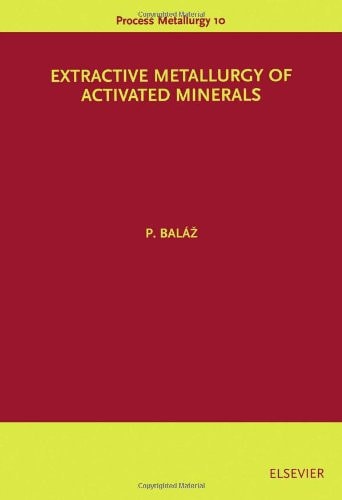
Extractive Metallurgy of Activated Minerals
0
0
As an Amazon Associate and affiliate partner, Menrva Books earns from qualifying purchases. Learn more
Author Description
Product description Mechanical activation of solids is a part of mechanochemistry, the science with a sound theoretical foundation exhibiting a wide range of potential application. Mechanical activation itself is an innovative procedure where an improvement in technological processes can be attained via a combination of new surface area and defects formation in minerals. Mechanical activation is of exceptional importance in extractive metallurgy and mineral processing and this area forms the topic of this book and is the result of more than twenty years of research and graduate teaching in the field. In pyrometallurgy, the mechanical activation of minerals makes it possible to reduce their decomposition temperatures or causes such a degree of disordering that the thermal activation may be omitted entirely. The potential mitigation of environmental pollutants is becoming increasingly important in this context. The lowering of reaction temperatures, the increase of the rate and amount of solubility, preparation of water soluble compounds, the necessity for simpler and less expensive reactors and shorter reaction times are some of the advantages of mechanical activation in hydrometallurgy. The environmental aspects of these processes are particularly attractive. Several industrial processes are examined and their flowsheets are presented as succesful of activation. In these processes, the introduction of a mechanical activation step into the technological cycle significantly modifies the subsequent steps. The book is designed for researchers, teachers, operators and students in the areas of extractive metallurgy, mineral processing, mineralogy, solid state chemistry and materials science.It will encourage newcomers to the mechanochemistry to do useful research and discover novel applications in this field. Review Fathi Habashi, Laval University, Canada...The author has brilliantly exposed this field in a systematic manner, fully documenting his comprehensive studies w
Menrva's Summary
THE THESIS
This book investigates the principles and applications of mechanical activation in extractive metallurgy and mineral processing. The author, drawing on over twenty years of research and teaching, presents mechanical activation as an innovative procedure that enhances mineral processing through increased surface area and defect formation. The text details how this process can lower decomposition temperatures in pyrometallurgy, potentially eliminating the need for thermal activation, and offers advantages in hydrometallurgy such as increased solubility, preparation of water-soluble compounds, and reduced reaction times and costs. The environmental benefits of these mechanochemical approaches are also highlighted, with several industrial processes and their flowsheets examined as successful applications of activation.
THE SCOPE MAP
- Mechanical activation as a subset of mechanochemistry
- Principles of mechanical activation: surface area increase and defect formation
- Applications in extractive metallurgy: pyrometallurgy and hydrometallurgy
- Reduction of decomposition temperatures and omission of thermal activation in pyrometallurgy
- Advantages in hydrometallurgy: lower reaction temperatures, increased solubility, preparation of water-soluble compounds
- Environmental benefits of mechanical activation processes
- Examination of industrial processes and their flowsheets
- Target audience: researchers, teachers, operators, and students in metallurgy, mineral processing, mineralogy, solid state chemistry, and materials science
THE AUTHORITY PERSPECTIVE
The book is designed for a specialized audience of researchers, teachers, operators, and students in fields such as extractive metallurgy, mineral processing, mineralogy, solid state chemistry, and materials science. It aims to encourage newcomers to mechanochemistry to conduct research and discover novel applications. The review from Fathi Habashi of Laval University notes that the author has systematically and brilliantly exposed the field, fully documenting comprehensive studies.
Page Count:
292
Publication Date:
2000-05-12
Publisher:
Elsevier Science
ISBN-10:
0444502068
ISBN-13:
9780444502063
Science
Non-Fiction
Solid state chemistry
Community Tags
Similar Books