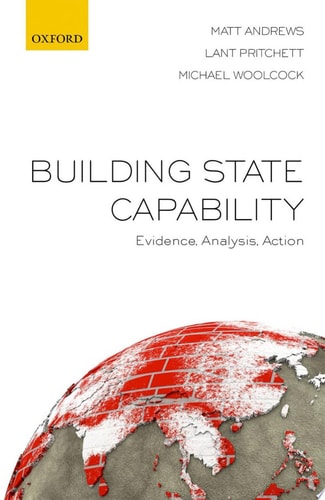
Building State Capability: Evidence, Analysis, Action
0
0
As an Amazon Associate and affiliate partner, Menrva Books earns from qualifying purchases. Learn more
Author Description
Governments Play A Major Role In The Development Process, And Constantly Introduce Reforms And Policies To Achieve Developmental Objectives. Many Of These Interventions Have Limited Impact, However; Schools Get Built But Children Don't Learn, It Systems Are Introduced But Not Used, Plans Are Written But Not Implemented. These Achievement Deficiencies Reveal Gaps In Capabilities, And Weaknesses In The Process Of Building State Capability. This Book Addresses These Weaknesses And Gaps. It Starts By Providing Evidence Of The Capability Shortfalls That Currently Exist In Many Countries, Showing That Many Governments Lack Basic Capacities Even After Decades Of Reforms And Capacity Building Efforts. The Book Then Analyses This Evidence, Identifying Capability Traps That Hold Many Governments Back. Introduction: The Long Voyage Of Discovery -- The Big Stuck In State Capability -- Looking Like A State: The Seduction Of Isomorphic Mimicry -- Premature Load Bearing: Doing Too Much Too Soon -- Capability For Policy Implementation -- What Type Of Organization Capability Is Needed? -- The Challenge Of Building (real) State Capability For Implementation -- Doing Problem-driven Work -- The Searchframe: Doing Experimental Iterations -- Managing Your Authorizing Environment -- Building State Capability At Scale Through Groups. Matt Andrews, Lant Pritchett, And Michael Woolcock. This Edition Previously Issued In Print: 2017. Includes Bibliographical References And Index. English
Menrva's Summary
THE THESIS
This book investigates why government reform efforts frequently fail to produce tangible improvements in state capability despite decades of investment. The authors, all experts in international development and public policy, argue that many governments fall into 'capability traps' caused by isomorphic mimicry—adopting the appearance of functional institutions without achieving actual performance. They propose a framework centered on problem-driven, iterative adaptation to build genuine implementation capacity within complex authorizing environments.
THE SCOPE MAP
What You Will Find
- Analysis of 'capability traps' and the failure of standard reform models
- The 'Problem Driven Iterative Adaptation' (PDIA) methodology
- Strategies for managing authorizing environments and scaling reform efforts
- Evidence-based critique of premature load-bearing in state institutions
Scope Limits
- Does not provide a universal blueprint for all political systems
- Focuses primarily on institutional implementation rather than political theory or electoral reform
THE AUTHORITY PERSPECTIVE
Experts in development economics and public administration frequently cite this work as a foundational text for understanding why top-down institutional reforms often stall. Readers often note the practical, methodology-heavy nature of the prose, which prioritizes actionable implementation strategies over abstract theoretical discourse.
Page Count:
0
Publication Date:
1900-01-01
Publisher:
Oxford University Press,
ISBN-10:
0191810347
ISBN-13:
9780191810343
Governance
Public Policy
Institutional Reform
State The
Community Tags
Similar Books