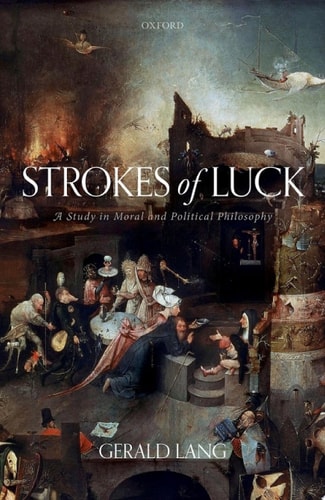
Strokes of Luck: A Study in Moral and Political Philosophy
0
0
As an Amazon Associate and affiliate partner, Menrva Books earns from qualifying purchases. Learn more
Author Description
Strokes of Luck provides a detailed and wide-ranging examination of the role of luck in moral and political philosophy. The first part tackles debates in moral luck, which are concerned with the assignment of blameworthiness to individuals who are separated only by lucky differences. 'Anti-luckists' think that one who, for example, attempts and succeeds in an assassination and one who attempts and fails are equally blameworthy. This book defends an anti-anti-luckist argument, according to which the successful assassin is more blameworthy than the unsuccessful one. Moreover, the successful assassin is, all things equal, a worse person than the unsuccessful one. The worldly outcomes of our acts can make an all-important difference, not only to how bad our acts can be deemed, but to how bad we are. The second part enters into debates about distributive justice. Lang argues that the attempt to neutralize luck in the distribution of advantages among individuals does not deserve its prominence in political philosophy: the 'luck egalitarian' programme is flawed. A better way forward is to re-invest in John Rawls's 'justice as fairness', which demonstrates a superior way of taming the bad effects of luck and unchosen disadvantage.
Menrva's Summary
THE THESIS
This book investigates the extent to which luck should influence moral assessment and the distribution of societal resources. Gerald R. Lang, a scholar in moral and political philosophy, evaluates the tension between outcome-based moral judgment and the desire to neutralize chance in social systems. He challenges the prevailing 'luck egalitarian' framework, proposing instead a return to the principles of justice as fairness to better address unchosen disadvantages.
THE SCOPE MAP
What You Will Find
- Analysis of moral luck and the assignment of blameworthiness
- Critique of luck egalitarianism in political theory
- Re-evaluation of John Rawls's justice as fairness framework
- Argumentation regarding the moral significance of worldly outcomes
Scope Limits
- Does not provide a comprehensive history of all luck-based philosophical theories
- Focuses primarily on analytic moral and political frameworks rather than applied policy implementation
THE AUTHORITY PERSPECTIVE
Experts recognize this work as a rigorous contribution to contemporary debates on moral responsibility and distributive justice. Readers frequently note the academic density of the prose, which is intended for those already familiar with the nuances of Rawlsian theory and analytic ethics.
Page Count:
300
Publication Date:
2021-01-01
Publisher:
OUP Oxford
ISBN-10:
0192639021
ISBN-13:
9780192639028
Philosophy
Moral Philosophy
Distributive Justice
Political Philosophy
Fortune
Ethics
Community Tags
Similar Books