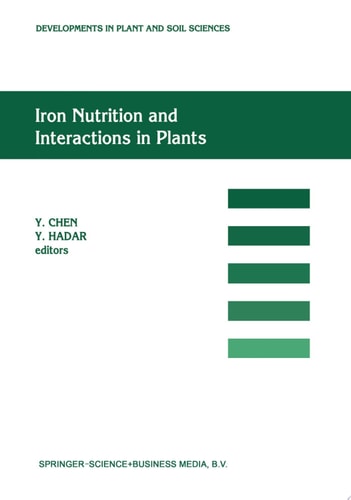
Iron Nutrition and Interactions in Plants
0
0
As an Amazon Associate and affiliate partner, Menrva Books earns from qualifying purchases. Learn more
Author Description
Many agricultural crops worldwide, especially in semi-arid climates, suffer from iron deficiencies. Among plants sensitive to iron deficiency are apples, avocado, bananas, barley, beans, citrus, cotton, grapes, peanuts, pecans, potatoes, sorghum, soybeans, and numerous ornamental plants. Deficiencies are usually recognized by chlorotic, in new leaves and are typically found among sensitive crops grown in calcareous or yellowed, interveinal areas soils which cover over 30% of the earth's land surface. Iron deficiency may lead, in extreme cases, to complete crop failure. In intensive agriculture on calcareous soils, iron often becomes a major limiting nutrient for optimal crop production, thus, correction of iron deficiency is required. Various chemicals and practices are available. They are, however, costly and do not always result in a complete remedy of the deficiency. Crucial questions relative to the cost-benefit equation such as the recovery rate of plants and the long-term fertilizing effect have not yet been resolved. The complexity of iron nutrition problems requires an understanding of the chemistry of iron oxides in soils, of the chemistry of both natural and synthetic chelates, of rhizosphere microbiology and biochemistry, and of the physiological involvement of the plant in iron uptake and transport.
Menrva's Summary
THE THESIS
Iron deficiency poses a significant threat to global agriculture, particularly in semi-arid regions, leading to reduced crop yields and, in severe cases, crop failure. Many economically important crops, including apples, citrus, soybeans, and barley, are highly sensitive to iron scarcity, especially when grown in calcareous soils which constitute a substantial portion of the Earth's land surface. While various methods exist to correct iron deficiency, they are often expensive, not entirely effective, and lack resolution on long-term benefits and plant recovery rates. Addressing these complex issues necessitates a deep understanding of soil chemistry, chelate properties, rhizosphere microbiology, and plant physiology related to iron uptake and transport.
THE SCOPE MAP
- The challenges of iron deficiency in agricultural crops worldwide, with a focus on semi-arid climates.
- Identification of plant species particularly sensitive to iron deficiency.
- The role of soil type, specifically calcareous soils, in exacerbating iron deficiency.
- Analysis of current methods for correcting iron deficiency, including their costs and limitations.
- Discussion of crucial unresolved questions regarding recovery rates and long-term fertilizing effects.
- Exploration of the complex interdisciplinary factors involved in iron nutrition, including soil chemistry, chelate chemistry, rhizosphere microbiology, and plant physiology.
THE AUTHORITY PERSPECTIVE
This collection of proceedings from the Fifth International Symposium on Iron Nutrition and Interactions in Plants offers a comprehensive overview of the challenges and scientific inquiries surrounding iron deficiency in agriculture. The papers likely address the multifaceted nature of the problem, drawing on expertise from soil science, plant physiology, and chemistry. The focus on practical agricultural concerns, such as crop sensitivity and the limitations of current remediation techniques, suggests a readership of researchers, agronomists, and agricultural professionals seeking in-depth understanding and potential solutions.
Page Count:
380
Publication Date:
2012-12-06
Publisher:
Springer Science & Business Media
ISBN-10:
9401132941
ISBN-13:
9789401132947
Science
Non-Fiction
Agriculture
Soil Science
Plant Science
Community Tags
Similar Books