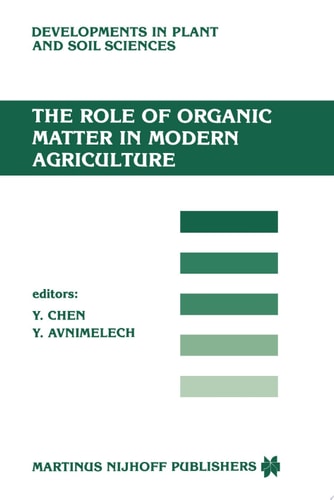
The Role of Organic Matter in Modern Agriculture
0
0
As an Amazon Associate and affiliate partner, Menrva Books earns from qualifying purchases. Learn more
Author Description
The use of organic residues as a means of maintaining and increasing soil fertility is of long-standing. This tradition has been somewhat neglected since the introduc tion of mineral fertilizers at low cost. More and more farmers and scientists are now showing renewed interest in the proper and effective use of org~tnic residues, composts and other recycled organic additives. The role and function of organic amendments in modern agricultural systems have become topics of major interest in the scientific and agricultural communities. Research work on residue disposal has provided new concepts on the interaction between organic components and soils as well as new handling technologies (e. g. pelletizing of organic residues). The trend to conserve energy has led scientists to study the minimal tillage system, to find ways of replacing conventional inorganic fertilizers with natural organic prod ucts or microbial preparations, and to develop new composting methods. The drive to achieve higher yields in commercial greenhouse farming has led to a search for optimum substrates as growth media and for improved management techniques. This has led to the introduction of organic substitutes for peat, nota bly those originating from agricultural wastes. Another important aspect is the current interest in organic farming, where use of synthetic chemicals is avoided or prohibited. An increasing percentage of the population in highly developed countries is willing to pay premium prices for food produced on soils where inorganic fertilizers and other agricultural chemicals have not been used.
Menrva's Summary
THE THESIS
The renewed interest in organic matter for agriculture stems from a historical practice that was overshadowed by the advent of inexpensive mineral fertilizers. The book explores the evolving role of organic residues, composts, and recycled organic additives in modern farming systems, driven by scientific inquiry and practical application. It details new concepts in soil-organic matter interaction, advancements in handling technologies like pelletizing, and the exploration of minimal tillage systems. Furthermore, it addresses the development of organic substitutes for traditional growth media in commercial greenhouse farming and the growing demand for organically produced food.
THE SCOPE MAP
- Historical context of organic matter use in agriculture
- Impact of mineral fertilizers on traditional practices
- Renewed scientific and farmer interest in organic residues
- New concepts in soil-organic matter interaction
- Advancements in handling technologies (e.g., pelletizing)
- Minimal tillage systems and energy conservation
- Organic substitutes for peat in greenhouse farming
- Principles and market demand for organic farming
THE AUTHORITY PERSPECTIVE
This book addresses the significant resurgence of interest in organic matter within agricultural practices, a field that saw a decline with the widespread adoption of synthetic fertilizers. It highlights the scientific and practical considerations driving this renewed focus, including advancements in residue management and the development of sustainable farming techniques. The text is positioned to inform researchers and practitioners on the multifaceted role of organic amendments in contemporary agriculture, from soil fertility to greenhouse cultivation and the burgeoning organic food market. The subject matter suggests a comprehensive overview for those invested in soil science and sustainable agricultural methods.
Page Count:
306
Publication Date:
2012-12-06
Publisher:
Springer Science & Business Media
ISBN-10:
9400944268
ISBN-13:
9789400944268
Non-Fiction
Science
Agriculture
Organic Farming
Composting
Soil Science
Community Tags
Similar Books