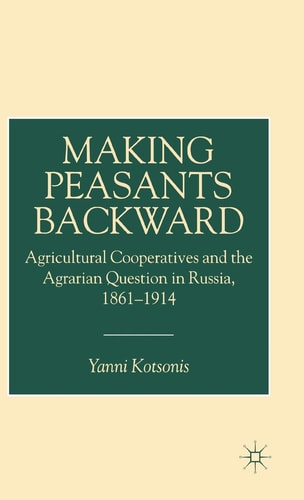
Making Peasants Backward: Agricultural Cooperatives and the Agrarian Question in Russia, 1861–1914
0
0
As an Amazon Associate and affiliate partner, Menrva Books earns from qualifying purchases. Learn more
Author Description
In this first monograph on the Russian cooperative movement before 1914, economic and social change is considered alongside Russian political culture. Looking at such historical actors as Sergei Witte, Piotr Stolypin, and Alexander Chaianov, and by tapping into several newly opened Russian local and state archives on peasant practice in the movement, Kotsonis suggests how cooperatives reflected a pan-European dilemma over whether and to what extent populations could participate in their own transformation.
Menrva's Summary
THE THESIS
This book investigates the complex role of agricultural cooperatives in shaping peasant life and national development in Tsarist Russia. Kotsonis examines the period between the emancipation of the serfs in 1861 and the outbreak of World War I in 1914, a time of significant economic and social upheaval. By analyzing newly accessible archival materials and considering the contributions of key figures like Sergei Witte and Piotr Stolypin, the study explores how these cooperatives both reflected and influenced peasant participation in their own transformation, situating the Russian experience within a broader European context.
THE SCOPE MAP
- Analysis of the Russian cooperative movement from 1861 to 1914.
- Consideration of economic and social change alongside Russian political culture.
- Examination of historical actors including Sergei Witte, Piotr Stolypin, and Alexander Chaianov.
- Utilization of newly opened Russian local and state archives on peasant practice.
- Exploration of the pan-European dilemma regarding population participation in societal transformation.
- Focus on the agrarian question and its impact on peasant backwardness.
- Discussion of the dual nature of cooperatives as tools for development and potential instruments of control.
THE AUTHORITY PERSPECTIVE
This monograph offers a detailed examination of the Russian cooperative movement prior to 1914, a topic previously underexplored. The author's engagement with newly opened archives and prominent historical figures provides a rich foundation for understanding the complexities of peasant participation in economic and social change. The work situates the Russian experience within a wider European debate on modernization and self-transformation. It is likely to be of significant interest to scholars of Russian history, economic history, and agrarian studies.
Page Count:
245
Publication Date:
1999-06-30
Publisher:
Palgrave Macmillan UK
ISBN-10:
0333725875
ISBN-13:
9780333725870
Economics
History
Non-Fiction
Social History
Russian History
Community Tags
Similar Books