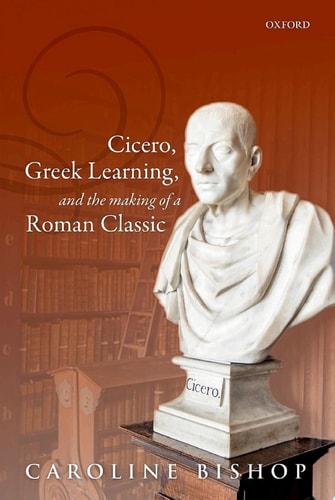
Cicero, Greek Learning, and the Making of a Roman Classic
0
0
As an Amazon Associate and affiliate partner, Menrva Books earns from qualifying purchases. Learn more
Author Description
The Roman statesman, orator, and author Marcus Tullius Cicero is the embodiment of a classic, though only in part due to his subsequent reception. This volume demonstrates how Cicero's strategic adaptation of classic Greek texts allowed him to envision and create texts with classical authority for a parallel Roman canon.
Menrva's Summary
THE THESIS
This volume investigates how Marcus Tullius Cicero strategically adapted Greek intellectual traditions to establish a distinct Roman literary canon that possessed its own classical authority. Caroline Bishop, a scholar of classical literature, utilizes a rigorous analysis of Cicero's translations and philosophical dialogues to argue that his engagement with Greek texts was a deliberate political and intellectual act. By examining the reception of authors like Plato, Aristotle, and Demosthenes, the book demonstrates how Cicero navigated Roman ambivalence toward Greek culture to position himself as the architect of a new, authoritative Roman intellectual identity.
THE SCOPE MAP
What You Will Find
- Analysis of Cicero's engagement with Aratus, Plato, Aristotle, and Demosthenes.
- Examination of Roman epistolary theory and the construction of personal letter collections.
- Discussion of the intersection between Hellenistic philosophy and Roman political rhetoric.
Scope Limits
- The text focuses primarily on Cicero's literary and philosophical production rather than a comprehensive biographical account of his political career.
- It does not provide an exhaustive history of all Roman translations of Greek works, limiting its scope to those relevant to Cicero's specific project of canon-building.
THE AUTHORITY PERSPECTIVE
Scholars in the field of classical studies recognize this work as a nuanced contribution to the understanding of Roman intellectual history and the mechanics of literary reception. Readers frequently note the academic density of the prose, which is tailored for researchers and students of Latin literature and ancient philosophy.
Page Count:
0
Publication Date:
1900-01-01
Publisher:
Oxford University Press,
ISBN-10:
0191867942
ISBN-13:
9780191867941
Biography
Philosophy
History
Literary Criticism
Ancient - Rome
Criticism and interpretationCicero Marcus Tullius