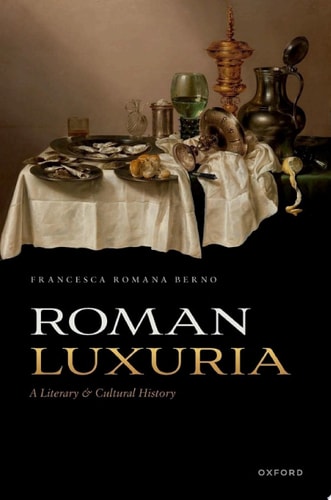
Roman Luxuria: A Literary and Cultural History
0
0
As an Amazon Associate and affiliate partner, Menrva Books earns from qualifying purchases. Learn more
Author Description
In classical Latin, luxuria means 'desire for luxury'; it is linked with the ideas of excess and deviation from a standard. It is in most cases labelled as a vice which contrasts with the innate frugal nature of the Romans. Latin authors do not see it as endemic but as an import from the East in the aftermath of military conquests—and as a cause of fatal decline. Following these etymological and semantic origins, Roman Luxuria: A Literary and Cultural History discusses the influence of Greek culture on the Roman concept and the peculiar characteristics of Roman luxuria. It analyses Roman views on luxuria through close readings in historical order from Cato the Elder, who regards luxuria as the opposite of the ideal Roman way of life, to the Christian poet Prudentius, who represents it in an allegorical fight with Sobriety. The book attends both to key authors and to wider literary genres, such as historiography and satire. Particular consideration is given to the rhetorical device of personification, which can be traced from the first appearances of luxuria in Latin literature to those of late antiquity. Berno devotes detailed attention to Seneca the Younger, whose work is often preoccupied with this passion. Seneca both defends himself from the charge of luxuria and violently attacks it in others, describing it as the archenemy of a philosophical life. Along the centuries, the focus on luxuria shifts from the economic sphere (and the waste of money) to the erotic, to the extent that in the Christian world it becomes one of the Seven Capital Sins representing the vice of lust.
Menrva's Summary
THE THESIS
This book investigates the evolution of the Roman concept of luxuria, examining how it transformed from a perceived economic vice of excess into a moral and erotic category of sin. Francesca Romana Berno, a scholar of classical literature, utilizes a chronological analysis of Latin texts to demonstrate how Roman authors constructed luxuria as a foreign corruption. By tracing this concept from the early Republic through late antiquity, the author argues that the term served as a critical rhetorical tool for defining Roman identity against perceived external threats.
THE SCOPE MAP
What You Will Find
- A chronological survey of Latin literature from Cato the Elder to Prudentius
- Analysis of the rhetorical device of personification in classical texts
- Detailed examination of Seneca the Younger's philosophical stance on luxury
- Exploration of the shift from economic waste to erotic lust in the definition of the term
Scope Limits
- The study focuses primarily on literary and rhetorical representations rather than archaeological or purely economic evidence
- It does not provide an exhaustive history of Roman material culture or trade practices
THE AUTHORITY PERSPECTIVE
Experts recognize this work as a rigorous philological study that clarifies the semantic shifts of a central Roman moral concept. Readers frequently note the academic density of the prose, which makes it a valuable resource for students of classical rhetoric and intellectual history.
Page Count:
296
Publication Date:
2023-01-01
Publisher:
OUP Oxford
ISBN-10:
0192661523
ISBN-13:
9780192661524
Philosophy
History
English
Cultural History
Literary Criticism
Ancient - Rome
English & College Success