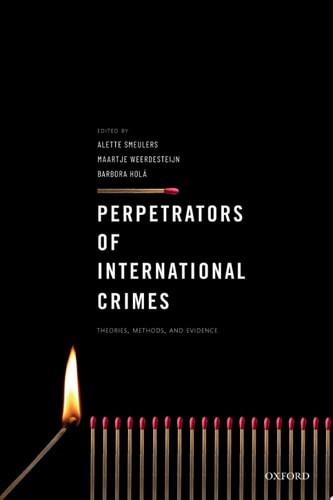
Perpetrators of International Crimes: Theories, Methods, and Evidence
0
0
As an Amazon Associate and affiliate partner, Menrva Books earns from qualifying purchases. Learn more
Author Description
Scholars from different disciplinary backgrounds have studied why perpetrators of international crimes commit these horrendous acts. Initially, historians and psychologists focused on this debate, which was heavily centred on the Second World War. Over the years, scholars with more diverse disciplinary backgrounds, studying a wide array of cases, using both qualitative and quantitative research methods, began to investigate perpetrators of international crimes and terrorism. Recently, this multi- and interdisciplinary debate has become known as perpetrator studies. This is the first book to take stock of the state of the art of this new field of study. It analyses the most prominent theories, methods, and evidence to determine what we know and what we think we know about perpetrators, as well as the ethical implications of gathering this knowledge. It traces the development of perpetrator studies while pushing the boundaries of the field by including contributions from authors from a wide array of disciplines, including criminology, history, law, sociology, psychology, political science, religious studies, and anthropology. Authors cover numerous case studies, including prominent ones such as Nazi Germany, Rwanda, and the former Yugoslavia, but also those that are relatively under-researched and more recent, such as Sri Lanka and the Islamic State, and use various research methods, including but not limited to, trial observations and interviews.
Menrva's Summary
THE THESIS
This book investigates the foundational theories, methodologies, and empirical evidence that define the emerging interdisciplinary field of perpetrator studies. The authors, Alette Smeulers, Barbora Holá, and Maartje Weerdesteijn, synthesize contributions from criminology, history, law, sociology, psychology, and anthropology to evaluate current academic understanding of why individuals commit international crimes. By examining both historical and contemporary case studies, the text establishes a framework for analyzing the motivations and actions of perpetrators while addressing the ethical challenges inherent in this research.
THE SCOPE MAP
What You Will Find
- A comprehensive survey of the development of perpetrator studies as an academic discipline.
- Analysis of diverse research methodologies including trial observations and qualitative interviews.
- Comparative studies of international crimes in Nazi Germany, Rwanda, the former Yugoslavia, Sri Lanka, and the Islamic State.
Scope Limits
- The text focuses primarily on the academic and theoretical synthesis of the field rather than providing a singular, unified psychological profile of all perpetrators.
THE AUTHORITY PERSPECTIVE
Experts identify this work as a foundational text that successfully bridges the gap between disparate academic disciplines studying mass violence. Readers frequently note the academic rigor of the prose, which serves as a primary reference for students and researchers entering the field of international criminal justice.
Page Count:
0
Publication Date:
2019-01-01
Publisher:
Oxford University Press
ISBN-10:
019186837X
ISBN-13:
9780191868375
History
Psychology
Sociology
Criminology
International Law