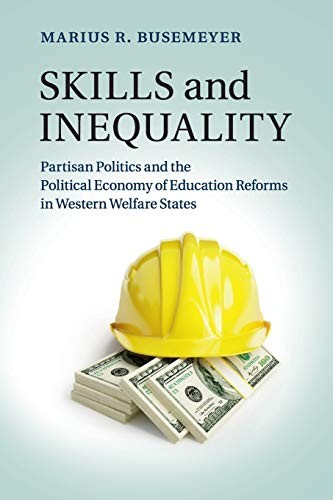
Skills and Inequality
0
0
As an Amazon Associate and affiliate partner, Menrva Books earns from qualifying purchases. Learn more
Author Description
Skills and Inequality studies the political economy of education and training reforms from the perspective of comparative welfare state research. Highlighting the striking similarities between established worlds of welfare capitalism and educational regimes, Marius R. Busemeyer argues that both have similar political origins in the postwar period. He identifies partisan politics and different varieties of capitalism as crucial factors shaping choices about the institutional design of post-secondary education. The political and institutional survival of vocational education and training as an alternative to academic higher education is then found to play an important role in the later development of skill regimes. Busemeyer also studies the effects of educational institutions on social inequality and patterns of public opinion on the welfare state and education. Adopting a multi-method approach, this book combines historical case studies of Sweden, Germany, and the United Kingdom with quantitative analyses of macro-level aggregate data and micro-level survey data
Menrva's Summary
THE THESIS
This book investigates the political economy of education and training reforms through the lens of comparative welfare state research. Marius R. Busemeyer argues that established welfare capitalist systems and educational regimes share similar political origins and institutional designs, shaped by partisan politics and varieties of capitalism. The survival of vocational training as an alternative to academic higher education is presented as a key factor in skill regime development. The work further examines the impact of these educational institutions on social inequality and public opinion regarding the welfare state and education.
THE SCOPE MAP
- Comparative analysis of education and training reforms across different welfare state models.
- Examination of the political origins and institutional design of post-secondary education systems.
- Exploration of the role of vocational education and training in skill regimes.
- Analysis of the effects of educational institutions on social inequality.
- Study of public opinion on welfare states and education.
- Multi-method approach combining historical case studies (Sweden, Germany, UK) with quantitative data analysis (macro and micro levels).
THE AUTHORITY PERSPECTIVE
The book adopts a comparative welfare state research perspective to analyze the political economy of education and training reforms. It posits that similarities in educational regimes and welfare capitalism stem from shared post-war political origins. The analysis highlights the influence of partisan politics and varieties of capitalism on institutional design in higher education. Furthermore, it explores the impact of these systems on social inequality and public opinion, utilizing a multi-method approach.
Page Count:
326
Publication Date:
2014-01-01
ISBN-10:
1107062934
ISBN-13:
9781107062931
Non-Fiction
Politics
Economics
Science
Education Policy
Comparative Politics
Community Tags
Other Editions(3)


Similar Books