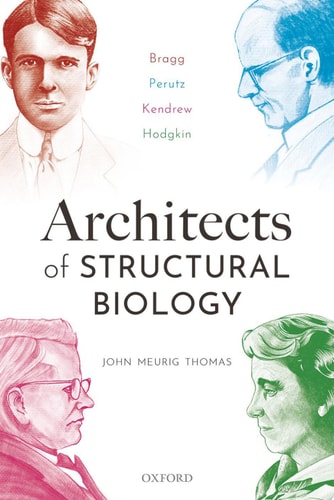
Architects of Structural Biology: Bragg, Perutz, Kendrew, Hodgkin
0
0
As an Amazon Associate and affiliate partner, Menrva Books earns from qualifying purchases. Learn more
Author Description
Designed for the non-specialist, the explanations and illustrations used here describe the work, personalities, collaborations, and idiosyncrasies of four of the most distinguished Nobel Laureates of the twentieth century. They exploited a discovery made over a century ago about the nature of X-rays, and thereby created a new branch of science. This enabled them to elucidate, in atomic detail, the structure and mode of action of molecules of the living world: enzymes, vitamins, and viruses, as well as antibiotics. Perutz and Kendrew, from their pioneering work using X-ray diffraction on haemoglobin and myoglobin, the proteins that transport and store oxygen in all animals, led them to establish in 1962 one of the most successful research centres ever - the Laboratory of Molecular Biology (LMB) in Cambridge. Medicines discovered there are used worldwide to treat leukaemia, arthritis, and other diseases. Their work also led to the creation in the United States of the Protein Data Bank that guides scientists in understanding the misfolding of proteins, which cause Alzheimer's disease, Parkinson's disease, and other neurodegenerative diseases. This book is first a memoir of these scientists and their contemporaries, many of them friends of the author. Second, it is an insight into the great excitement associated with structural molecular biology, which directly informs our understanding of ourselves. Third, it describes how two renowned research centres in the United Kingdom - the LMB and the Davy-Faraday Research Laboratory - achieved iconic status. It also highlights the importance of the popularization of science, of which Bragg, Perutz, and Kendrew, as well as Dorothy Hodgkin (who solved the structures of penicillin and vitamin B12) were experts.
Menrva's Summary
THE THESIS
This book investigates the scientific contributions and personal dynamics of four Nobel Laureates who founded the field of structural molecular biology. Author John Meurig Thomas, a distinguished chemist, utilizes his personal acquaintance with these scientists and archival records to document how their application of X-ray diffraction transformed the understanding of biological molecules. The text argues that the collaborative environment fostered at the Laboratory of Molecular Biology and the Davy-Faraday Research Laboratory was critical to the success of these researchers in mapping the atomic structures of proteins and viruses.
THE SCOPE MAP
What You Will Find
- Biographical profiles of Lawrence Bragg, Max Perutz, John Kendrew, and Dorothy Hodgkin
- Historical development of X-ray crystallography applications in biology
- Institutional history of the Laboratory of Molecular Biology (LMB) and the Davy-Faraday Research Laboratory
- Explanations of the structural determination of haemoglobin, myoglobin, penicillin, and vitamin B12
Scope Limits
- The text does not provide a comprehensive technical manual for X-ray diffraction methodology
- It does not cover the entirety of modern structural biology developments post-20th century
THE AUTHORITY PERSPECTIVE
Experts and readers frequently note the accessible prose style, which successfully translates complex biochemical concepts for a non-specialist audience. The book is widely regarded as a valuable historical record of the personal and professional relationships that defined a pivotal era in British scientific research.
Page Count:
0
Publication Date:
2020-01-01
Publisher:
Oxford University Press
ISBN-10:
0191888796
ISBN-13:
9780191888793
Non-Fiction
Science
Biography
Science History