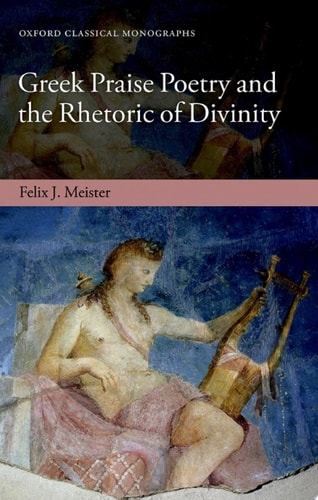
Greek Praise Poetry and the Rhetoric of Divinity
0
0
As an Amazon Associate and affiliate partner, Menrva Books earns from qualifying purchases. Learn more
Author Description
The Polar Dichotomy Between Man And God, And The Insurmountable Gulf Between Them, Are Considered A Fundamental Principle Of Archaic And Classical Greek Religion. Greek Praise Poetry And The Rhetoric Of Divinity Argues That Poetry Produced Between The Eighth And The Fifth Centuries Bc Does Not Present Such A Uniform View Of The World, Demonstrating Instead That Particular Genres Of Poetry May Assess The Distance Between Humans And Gods Differently. Discussion Focuses On Genres Where The Boundaries Appear To Be More Flexible, With Wedding Songs, Victory Odes, And Selected Passages From Tragedy And Comedy Taken As Case Studies That Illustrate That Some Human Individuals May, In Certain Situations, Be Presented As Enjoying A State Of Happiness, A Degree Of Beauty, Or An Amount Of Power Comparable To That Of The Gods. A Central Question Throughout Is Whether These Presentations Stem From An Individual Poet's Creative Ingenuity Or From The Conventional Ideological Repertoire Of The Respective Genre, And How This Difference Might Shape The Comparison Of A Human With The Gods. Another Important Question Concerns The Ritual Contexts In Which Some Of These Songs Would Have Been Performed, Expanding The Scope Of The Analysis Beyond Merely A Literary Device To Encompass A Fundamental Aspect Of Archaic And Classical Greek Culture.
Menrva's Summary
THE THESIS
This book investigates whether the frequent comparisons between humans and gods in archaic and classical Greek poetry represent a standard ideological convention or the unique creative choices of individual poets. Felix Johannes Meister examines the tension between the perceived insurmountable gulf separating mortals from the divine and the specific instances where human beauty, happiness, or power are depicted as god-like. By analyzing the rhetorical strategies employed in various poetic genres, the author argues that the boundary between the human and the divine was far more fluid and context-dependent than traditional religious scholarship suggests.
THE SCOPE MAP
What You Will Find
- Analysis of wedding songs, victory odes, and selected passages from Greek tragedy and comedy.
- Examination of the ritual contexts and performance settings for archaic and classical Greek poetry.
- Comparative study of literary devices used to bridge the gap between human and divine status.
Scope Limits
- The analysis is primarily restricted to poetry produced between the eighth and fifth centuries BC.
- The work does not provide an exhaustive survey of all Greek religious literature, focusing instead on specific genres where boundaries appear flexible.
THE AUTHORITY PERSPECTIVE
Scholars in the field of classics recognize this work as a nuanced contribution to the study of Greek religious ideology and poetic convention. Readers frequently note the academic density of the prose, which is intended for those with a background in classical philology and ancient history.
Page Count:
0
Publication Date:
1900-01-01
Publisher:
Oxford University Press,
ISBN-10:
0191882356
ISBN-13:
9780191882357
Religion
Poetry
History
Greek poetry
Ancient Greece
Literary Criticism
Latin poetry
Community Tags
Similar Books