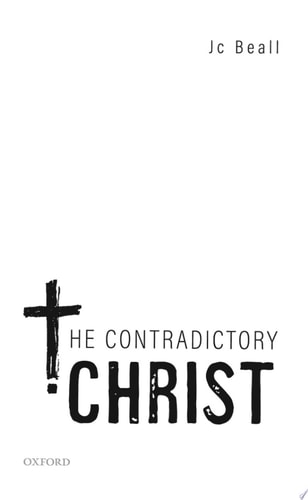
The Contradictory Christ
0
0
As an Amazon Associate and affiliate partner, Menrva Books earns from qualifying purchases. Learn more
Author Description
Cover -- The Contradictory Christ -- Copyright -- Dedication -- Preface -- Aim -- Previous Work -- Future Work -- Hope -- Target Audience -- Conventions Governing Style -- An Unsolicited Note On Reading The Book -- Acknowledgments -- Contents -- 1: Contradictory Christology -- 1.1 The Longstanding Christological Quest -- 1.2 The Central Thesis: Christ The Contradiction -- 1.3 Terminology: Contradiction And Contradictory Beings -- 1.4 The Rarity Of True Contradictory Theories -- 1.5 Summary And Looking Forward -- 2: Logic And Its Possibilities -- 2.1 Entailment Relations In General 2.1.1 Very Big Picture -- 2.1.2 Languages And Their Salient Parts -- 2.1.2.1 Alphabet And Other Bits -- 2.1.2.2 Singular Terms -- 2.1.2.3 Predicates -- 2.1.2.4 Sentences: Atomic -- 2.1.3 Meanings: Denotation, True-of And False-of Relations -- 2.1.3.1 Singular Terms: Denotation -- 2.1.3.2 Predicates: True-of And False-of -- 2.1.4 Meanings Of (atomic) Sentences: Truth And Falsity Conditions -- 2.1.5 Entailment Relations On A Language -- 2.2 The Role Of Logic In General And In Theology -- 2.2.1 Theology And Consequence -- 2.2.2 Consequence And (formal) Logical Consequence 2.2.3 Logic And Standard Logic -- 2.3 Logic: Subclassical -- 2.3.1 Formal Language -- 2.3.1.1 Syntax -- 2.3.1.2 Semantics: Towards Truth And Falsity Conditions -- 2.3.1.3 Atomic Sentences -- 2.3.1.4 Semantic Values For Molecular Sentences -- 2.4 Logic: The Target Consequence Relation -- 2.5 Salient Logical (in-) Validities -- 2.6 Chief Virtues Of This Account Of Logic -- 3: Seven Virtues -- 3.1 Simplicity -- 3.2 Avoiding Ad Hoc Changes In Meaning -- 3.3 Metaphysical Neutrality -- 3.4 Preserving The Principal Subject Of Christology -- 3.5 Balancing 'from Above' And 'from Below' 3.6 Preserving The Mystery Of The Hypostatic Union -- 3.7 Christology And The Obvious Need For Faith -- 3.8 Closing Big-picture Remarks -- 4: Some Objections -- 4.1 Methodological Issues -- 4.1.1 Your Theology Is False! -- 4.1.2 Truth Requires Coherenc
Menrva's Summary
THE THESIS
This work investigates whether the central tenets of Christology, specifically the hypostatic union, can be coherently understood through the lens of dialetheism and paraconsistent logic. J. C. Beall, a philosopher known for his work on logic and truth, applies formal logical frameworks to traditional theological claims. He argues that Christ can be understood as a contradictory being without violating logical consistency, provided one adopts a subclassical logic that allows for true contradictions.
THE SCOPE MAP
What You Will Find
- A formal logical framework for analyzing Christological claims
- An exploration of subclassical logic and entailment relations
- A set of seven virtues for evaluating theological theories
- Analysis of the hypostatic union as a potential site of contradiction
Scope Limits
- The text does not provide a comprehensive historical survey of all Christological debates
- It does not attempt to resolve theological disputes through traditional dogmatic or scriptural exegesis alone
THE AUTHORITY PERSPECTIVE
Scholars and philosophers of religion frequently note the high level of technical density in the prose, as the book requires a working knowledge of formal logic. Experts highlight this as a rigorous attempt to bridge the gap between analytic philosophy and systematic theology.
Page Count:
0
Publication Date:
1900-01-01
Publisher:
Oxford University Press,
ISBN-10:
0191886823
ISBN-13:
9780191886829
HumanityJesus Christ
Philosophy of
Christology
Jesus Christ
Theology
Logic
Metaphysics
Community Tags
Similar Books