Introspection: First-person Access in Science and Agency
0
0
As an Amazon Associate and affiliate partner, Menrva Books earns from qualifying purchases. Learn more
Author Description
Cover -- Introspection: First-person Access In Science And Agency -- Copyright -- Dedication -- Contents -- Preface -- Epigraph -- 1: Introspective Access And Introspective Method -- 1.1 The Basic Framework -- 1.1.1 The Reliability Of Introspective Access -- 1.1.2 The Reliability Of Introspective Methods -- 1.2 Calibration And Privacy -- 1.3 A Brief Outline Of The Book -- Part I: Introspective Inquiry: Introduction -- 2: The Problem Of Self-observation -- 2.1 Mill And James On The Problem Of Self-observation -- 2.2 Wundt On The Problem Of Self-observation 2.3 Gestalt Psychology And Phenomenological Method -- 2.4 Self-observation In Early Psychology -- 3: Varieties Of Introspective Methods In Introspectionist Psychology -- 3.1 The Method Of Systematic Introspection -- 3.2 Müller And The Methods Of Direct Introspection And Careful Retrospection -- 3.2.1 Müller's Critique Of Systematic Introspection -- 3.2.2 The Methods Of Restricted Inner Attention And Careful Retrospection -- 3.3 Wundt And The Method Of Controlled Inner Apprehension -- 3.3.1 Wundt's Critique Of Systematic Introspection -- 3.3.2 The Method Of Controlled Inner Apprehension 3.4 The Complexity Of Introspective Methods -- 4: The Problem Of Response Bias -- 4.1 A Methodological Challenge -- 4.2 Subjective And Objective Thresholds Of Perception -- 4.3 Response Bias And Subjective Report -- 4.4 The Distinction Between Objective And Subjective Measures Of Consciousness -- 5: Subjective Measures Of Consciousness -- 5.1 Confidence Ratings -- 5.2 Awareness Ratings -- 5.3 Subjective Access And Introspection -- 5.4 Common Sense And Metacognition -- 5.5 The Necessity Of Introspection In Consciousness Science -- 6: The Reliability Of Subjective Measures Of Consciousness 6.1 A Middle Ground Position -- 6.2 Global Versus Local Unreliability -- Part Ii: Introspective Kinds: Introduction -- 7: Introspective Access -- 7.1 Inner Attention -- 7.2 Inner Apprehension -- 7.3 Retrospection -- 7.4 The Basic Pictures And Empir
Menrva's Summary
THE THESIS
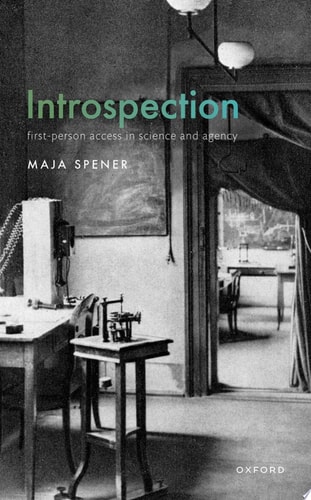
This book investigates the reliability and methodological validity of introspective access as a tool for scientific inquiry into consciousness and human agency. Maja Spener, a philosopher specializing in the philosophy of mind, constructs a framework that evaluates how subjective reports and inner apprehension can be integrated into objective scientific study. By examining the historical tensions between early psychology and modern consciousness science, the author argues for a nuanced understanding of how individuals access their own mental states.
THE SCOPE MAP
What You Will Find
- Historical analysis of introspective methods from Mill, James, and Wundt
- A detailed examination of response bias and subjective thresholds in perception
- A comparative study of confidence ratings and awareness ratings as measures of consciousness
- A proposed middle-ground position regarding the reliability of subjective reports
Scope Limits
- The text does not provide a comprehensive neurobiological account of consciousness
- It does not focus on clinical or therapeutic applications of introspection
THE AUTHORITY PERSPECTIVE
Experts in the philosophy of mind recognize this work as a rigorous contribution to the debate on the legitimacy of first-person data in cognitive science. Readers frequently note the academic density of the prose, which is intended for scholars and advanced students of philosophy and psychology.
Page Count:
0
Publication Date:
2024-01-01
Publisher:
New York : Oxford University Press,
ISBN-10:
0191904201
ISBN-13:
9780191904202
Psychology
Philosophy
Philosophy of
Epistemology
Introspection
Community Tags
Other Editions(2)
Similar Books













Reader Comments
Share Your Thoughts
No comments yet. Be the first to share your thoughts!