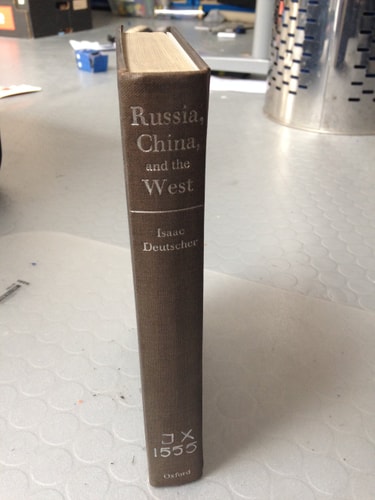
Russia, China, and the West: A Contemporary Chronicle, 1953-1966
0
0
As an Amazon Associate and affiliate partner, Menrva Books earns from qualifying purchases. Learn more
Author Description
Introduction -- 1. The Fall Of Beria -- Before The Trial -- Beria Is Shot -- 2. The Development Of Soviet Foreign Policy In 1954 -- Soviet Policy Towards Germany A Year After Stalin -- The Geneva Conference On The Far East -- A New Course In Moscow: Russia And China -- A New Course In Moscow: Changes In Eastern Europe -- 3. The Fall Of Malenkov -- The Issues Behind Malenkov's Resignation -- The Rise Of The Military -- The Roles Of Khrushchev And Bulganin -- 4. The Foreign Policy Of Malenkov's Successors -- The Retreat From Monolithism: Khrushchev In Belgrade -- Status Quo In Germany -- 5. The Twentieth Congress -- The Twentieth Congress Of The Soviet Communist Party -- Foreign Affairs At The Twentieth Congress -- The U.s.s. R. After The Twentieth Congress -- Stalin And The Soviet Leadership -- Molotov Resigns -- 6. Crisis In The Soviet Bloc -- The Polish And Hungarian Revolts -- The Causes Of The Crisis In Eastern Europe -- Shepilov's Exit -- Malenkov Returns To The Attack --^ 7. Mao And The Hundred Flowers Campaign -- 8. Khrushchev Gains The Ascendancy -- Khrushchev's Economic Reform -- The Anti-party Group -- Khrushchev, Malenkov, And The Stalinist Past -- Bonapartism In The Soviet Union -- Khrushchev Becomes Prime Minister -- 9. Khrushchev On The Defensive -- The Execution Of Imre Nagy -- Mao Abandons The Hundred Flowers Campaign -- Khrushchev's Domestic Opposition -- The Collapse Of Khrushchev's Diplomacy -- China's Pressure On Moscow -- 10. From The Twentieth To The Twenty-first Congress -- 11. Khrushchev's Diplomatic Initiatives -- The Soviet Perspective In Germany -- Khrushchev Goes To Washington -- Russia And The International Communist Movement -- The U-2 Incident -- The Collapse Of The Summit -- 12. The Deterioration Of Sino-soviet Relations -- The Bucharest Congress -- Algeria And The Sino-soviet Dispute -- The Conference Of The Eighty-one Parties -- Cuba And Indo-china -- The Sino-soviet Truce Breaks Down --^ 13. The Twenty-second Congress And The End Of
Menrva's Summary
THE THESIS
This work investigates the shifting geopolitical dynamics and internal power struggles within the Soviet Union and its relationship with China and the West during the critical transition period from 1953 to 1966. Isaac Deutscher, a noted historian and biographer of the Soviet era, utilizes his expertise in Marxist theory and Soviet political history to analyze the post-Stalinist landscape. He examines how the internal consolidation of power by figures like Khrushchev influenced foreign policy, the fracturing of the communist bloc, and the escalating tensions of the Cold War.
THE SCOPE MAP
What You Will Find
- Detailed analysis of Soviet leadership transitions from Malenkov to Khrushchev.
- Examination of the Sino-Soviet split and its impact on global communist movements.
- Historical accounts of the Polish and Hungarian revolts and the Twentieth Party Congress.
- Primary focus on diplomatic initiatives, including the Geneva Conference and the U-2 incident.
Scope Limits
- The text concludes abruptly in 1966 and does not cover the later stages of the Cold War or the final collapse of the Soviet Union.
- The analysis is primarily centered on high-level political and diplomatic maneuvers rather than social or cultural history.
THE AUTHORITY PERSPECTIVE
Scholars frequently cite this work as a significant contemporary record of Cold War diplomacy written by an observer with deep insight into Soviet internal politics. Readers often note the academic density of the prose, which assumes a high level of familiarity with mid-century geopolitical events.
Page Count:
374
Publication Date:
1970-01-01
Publisher:
Oxford University Press
ISBN-10:
0192111906
ISBN-13:
9780192111906
History
China
International relations
Cold War
Soviet Union
Community Tags
Similar Books