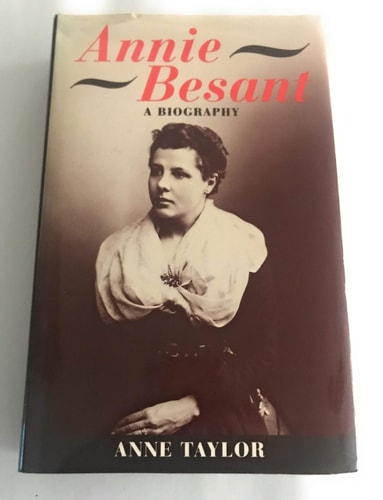
Annie Besant: A Biography
0
0
As an Amazon Associate and affiliate partner, Menrva Books earns from qualifying purchases. Learn more
Author Description
In her long life, Annie Besant embraced political, religious, and social causes with equal conviction and sincerity, courting ridicule and controversy by actively promoting unpopular ideas. At 26 she fled the shelter of marriage to an Anglican clergyman and renounced her religious upbringing by joining the National Secular Society. Under the influence of its president, Charles Bradlaugh, she wrote and lectured for the cause of Freethought, and in 1876, achieved nationwide fame by defending birth control in a public court. She converted to socialism and through her friendship with Bernard Shaw joined the Fabian Society. In 1888 Besant played a leading role in the Bryant and May match girls' strike and became Secretary of the trade union they founded. But by 1891 she had fallen out of sympathy with socialists and turned instead to Theosophy and its eccentric prophet, Madame Blavatsky. Thereafter she divided her life between England and the Theosophical Society's headquarters in India. She joined the Indian National Congress and was interned in 1917 for her passionate advocacy of Home Rule. In this, the first full-length biography of Annie Besant in thirty years, Taylor draws on previously unpublished letters to show that Besant was in love, not with Shaw, but with journalist W. Stead who rejected her advances. The book reveals for the first time the full extent of the Government of India's alarm at Besant's commanding position in the crisis of 1917, and her bid for political and religious power in India.
Menrva's Summary
THE THESIS
This biography investigates the complex trajectory of Annie Besant, a figure who navigated and influenced the most contentious political, religious, and social movements of the late 19th and early 20th centuries. Anne Taylor, a meticulous researcher, utilizes previously unpublished correspondence and government archives to reconstruct Besant's evolution from a secularist activist to a prominent leader in the Indian independence movement. The work argues that Besant's life was defined by a persistent, often controversial pursuit of ideological power and personal conviction across disparate global landscapes.
THE SCOPE MAP
What You Will Find
- Detailed account of the 1888 Bryant and May match girls' strike and early trade unionism.
- Analysis of the influence of Charles Bradlaugh and the National Secular Society on Besant's early career.
- Examination of the 1917 Indian Home Rule crisis and the British government's response to Besant's political influence.
- Insight into the personal dynamics between Besant, Bernard Shaw, and W. Stead.
- Exploration of the transition from Fabian Socialism to Theosophy under Madame Blavatsky.
Scope Limits
- The text focuses primarily on Besant's public and political life, with less emphasis on the theological intricacies of Theosophy itself.
- The narrative is constrained by the availability of private correspondence, specifically regarding her later years in India.
THE AUTHORITY PERSPECTIVE
Historians and scholars recognize this work as a significant contribution to the study of Victorian and Edwardian radicalism, particularly for its use of previously restricted government documents. Readers frequently note the academic rigor of the prose and the author's success in providing a balanced view of a polarizing historical figure.
Page Count:
408
Publication Date:
1992-05-07
Publisher:
Oxford University Press
ISBN-10:
0192117963
ISBN-13:
9780192117960
Biography
History
Religion
Theosophy
Womens Studies
19th Century
Community Tags
Similar Books