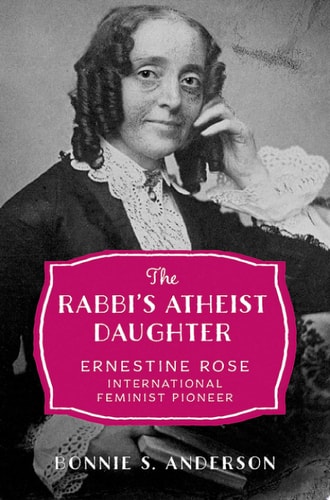
The Rabbi's Atheist Daughter: Ernestine Rose, International Feminist Pioneer
0
0
As an Amazon Associate and affiliate partner, Menrva Books earns from qualifying purchases. Learn more
Author Description
Known as "the queen of the platform," Ernestine Rose was more famous than her women's rights co-workers, Elizabeth Cady Stanton and Susan B. Anthony. By the 1850s, Rose had become an outstanding orator for feminism, free thought, and anti-slavery. Yet, she would gradually be erased from history for being too much of an outlier: an immigrant, a radical, and an atheist. In The Rabbi's Atheist Daughter, Bonnie S. Anderson recovers the unique life and career of Ernestine Rose. The only child of a Polish rabbi, Ernestine Rose rejected religion at an early age, successfully sued for the return of her dowry after rejecting an arranged betrothal, and left her family, Judaism, and Poland forever. In London, she became a follower of socialist Robert Owen and met her future husband, William Rose. Together they emigrated to New York in 1836. In the United States, Ernestine Rose rapidly became a leader in movements against slavery, religion, and women's oppression and a regular on the lecture circuit, speaking in twenty-three of the thirty-one states. She challenged the radical Christianity that inspired many nineteenth-century women reformers and yet, even as she rejected Judaism, she was both a victim and critic of antisemitism, as well as nativism. In 1869, after the Civil War, she and her husband returned to England, where she continued her work for radical causes. By the time women achieved the vote, for which she tirelessly advocated throughout her long career, her pioneering contributions to women's rights had been forgotten. The Rabbi's Atheist Daughter restores Ernestine Rose to her rightful place in history and offers an engaging account of her international activism.
Menrva's Summary
THE THESIS
This biography investigates how Ernestine Rose, a prominent nineteenth-century orator and activist, was systematically erased from historical records due to her radical views on religion and her status as an immigrant. Bonnie S. Anderson, a historian specializing in women's history, utilizes archival research and primary source documentation to reconstruct Rose's life. The book argues that Rose's rejection of organized religion and her advocacy for free thought made her an outlier among her contemporaries, leading to her eventual exclusion from the mainstream narrative of the women's suffrage movement.
THE SCOPE MAP
What You Will Find
- A detailed account of Rose's early life in Poland and her departure from Judaism.
- Analysis of her influence on the American lecture circuit and her collaboration with figures like Robert Owen.
- Examination of her intersectional struggles against antisemitism, nativism, and gender-based oppression.
Scope Limits
- The text focuses primarily on her public activism and political career rather than an exhaustive psychological profile of her private life.
THE AUTHORITY PERSPECTIVE
Historians and scholars of the nineteenth-century reform movements recognize this work as a significant recovery project that addresses a notable gap in feminist historiography. Readers frequently note the meticulous archival detail Anderson provides to contextualize Rose's contributions within the broader landscape of American social reform.
Page Count:
264
Publication Date:
2016-01-01
Publisher:
Oxford University Press
ISBN-10:
0190626399
ISBN-13:
9780190626396
Biography
History
English
19th Century
English & College Success
Feminism
Womens Studies
Biography Autobiography
Feminists
Social Reform
American History
Social reformers
Womens rights
Community Tags
Similar Books