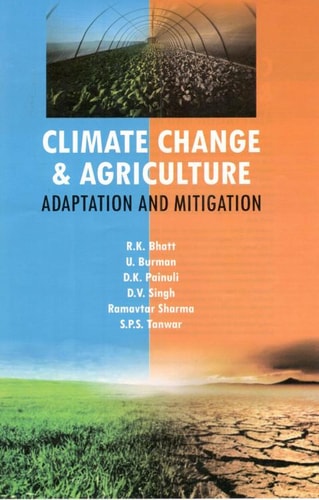
Climate Change & Agriculture: Adaptation & Mitigation
0
0
As an Amazon Associate and affiliate partner, Menrva Books earns from qualifying purchases. Learn more
Author Description
Atmospheric carbon dioxide (007) concentration crossed 400 ppm in 2015 from 279 ppm of preindustrial period. Similarly, compared to preindustrial era, the methane (CH) concentration increased from 722 ppb to 1800 ppb and nitrous oxide (N20) concentration from 270 ppb to 323 ppb in 2011. Increasing GHGs concentration in the atmosphere has created radiative imbalance resulting in more energy fromthe sun entering than exiting thetep ofthe earth's atmosphere. All the above, individually and collectively, adversely influence the total agriculture productivity. Increased awareness during 19905 about adverse effect of deforestation and other land-use changes on 002 stock coupled with more emphasis on afforestation has checked rise in atmospheric carbun-di-oxide in the recentyears. Besides the direct adverse impacts of climate change on crop growth and development in arid regions, indirect effects through reduced availability of rain water, increased irrigation demand, soil degradation due to loss of soil organic matter, etc. are very likely to adversely affect the arid agriculture. Altered temperature and precipitation regimes are most likely to change the composition of plant communities. Forage species, particularly perennial grasses, cover large land area and also serve an important role as source and sinks for atmospheric carbon. Considering the importance of changing climate on arid ecosystem, the present compilation, covering all the relevant aspects related to arid agriculture, has twenty-nine extensively reviewed chapters bearing the mark of rich experience of the authors working in this ecosystem since long. The risks related to climate change have been elaborated, and various adaptation and mitigation strategies and policies to combat climate change have also been covered.
Menrva's Summary
THE THESIS
This compilation investigates the profound impacts of escalating greenhouse gas concentrations on global agriculture and explores strategies for adaptation and mitigation. The book details the increase in atmospheric carbon dioxide, methane, and nitrous oxide, explaining how these changes create a radiative imbalance that adversely affects agricultural productivity. It specifically addresses the challenges faced by arid agriculture, including reduced water availability, increased irrigation demands, and soil degradation, and discusses how altered temperature and precipitation regimes can change plant communities and their role in carbon cycling. The work compiles twenty-nine extensively reviewed chapters from authors with long-standing experience in arid ecosystems, aiming to elaborate on climate change risks and present policies and strategies to combat them.
THE SCOPE MAP
- Analysis of increasing atmospheric concentrations of CO2, CH4, and N2O and their impact on global agriculture.
- Detailed examination of the direct and indirect adverse effects of climate change on crop growth and development in arid regions.
- Discussion of challenges such as reduced water availability, increased irrigation demand, and soil degradation in arid agriculture.
- Exploration of how altered temperature and precipitation regimes influence plant communities, particularly perennial grasses.
- Identification of the role of forage species as sources and sinks for atmospheric carbon.
- Elaboration on the risks associated with climate change in arid ecosystems.
- Presentation of various adaptation and mitigation strategies and policies to combat climate change in agriculture.
- Compilation of twenty-nine extensively reviewed chapters by experienced authors in arid ecosystems.
THE AUTHORITY PERSPECTIVE
This compilation is presented as a comprehensive overview of climate change's impact on agriculture, particularly in arid regions. It aims to provide detailed insights into the risks and to outline adaptation and mitigation strategies based on the extensive experience of its contributing authors. The work is structured to cover all relevant aspects of arid agriculture in the face of changing climate conditions, offering a collection of reviewed chapters for a specialized audience. The focus is on presenting practical and policy-oriented solutions derived from long-term research within these ecosystems.
Page Count:
1
Publication Date:
2016-06-30
Publisher:
National Book Network
ISBN-10:
9385055879
ISBN-13:
9789385055874
Science
Non-Fiction
Agriculture
Ecosystems
Climate Change
Community Tags
Similar Books














