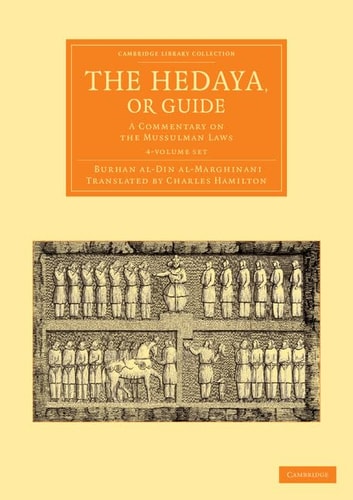
The Hedaya, Or Guide A Commentary on the Mussulman Laws
0
0
As an Amazon Associate and affiliate partner, Menrva Books earns from qualifying purchases. Learn more
Author Description
Composed in the twelfth century by the leading Muslim jurist Burhan al-Din al-Marghinani (1135-97), the original Arabic al-Hidāyah remains a central text of Islamic personal law. This English translation, from a Persian version of the work, was prepared by the orientalist Charles Hamilton (c.1752-92) for the East India Company in 1791. Although since superseded, it remains a fascinating document in the history of colonial jurisprudence. The legal system was central to the entrenchment of British rule in India, providing the framework for active control of civil administration and the courts. Translations of Islamic texts were intended to remove the language barrier for colonial officials, and blurred British and native law for the first time. Hamilton's text is one such, and its dedication to Warren Hastings and lengthy preliminary section outline its purpose and composition. Topics covered in the volumes include marriage, divorce, property, punishments and slavery.
Menrva's Summary
THE THESIS
This work investigates the foundational principles of Islamic personal law as understood and codified in the twelfth century. Composed by the preeminent jurist Burhan al-Din al-Marghinani, the original Arabic text, al-Hidāyah, has historically served as a cornerstone of Islamic jurisprudence. This specific English translation, prepared by Charles Hamilton for the East India Company in 1791, offers a unique perspective on the intersection of Islamic legal traditions and colonial administration in India. The translation itself is a historical document, reflecting the colonial era's approach to understanding and implementing foreign legal systems.
THE SCOPE MAP
- Central tenets of Islamic personal law concerning marriage, divorce, and property.
- Discussions on legal punishments and the institution of slavery within the historical Islamic context.
- Analysis of the historical significance of Islamic legal texts for colonial jurisprudence in India.
- Insights into the translation process and the motivations behind preparing such texts for the East India Company.
- The preliminary sections detailing the purpose and composition of Hamilton's translation.
THE AUTHORITY PERSPECTIVE
This translation of the al-Hidāyah is recognized as a significant historical document, particularly for its role in the context of British colonial rule in India. Its value lies not only in its content, which outlines key aspects of Islamic personal law, but also in its function as a tool for colonial administrators. The text provides a window into the historical engagement between British jurisprudence and Islamic legal traditions, highlighting the complexities of governing diverse populations. While superseded by modern scholarship, Hamilton's 1791 translation remains a fascinating study for historians of law, colonialism, and Islamic studies.
Page Count:
2676
Publication Date:
2013-02-28
Publisher:
Cambridge University Press
ISBN-10:
1108055397
ISBN-13:
9781108055390
Religion
History
Non-Fiction
Islamic Studies
Law
Community Tags
Similar Books