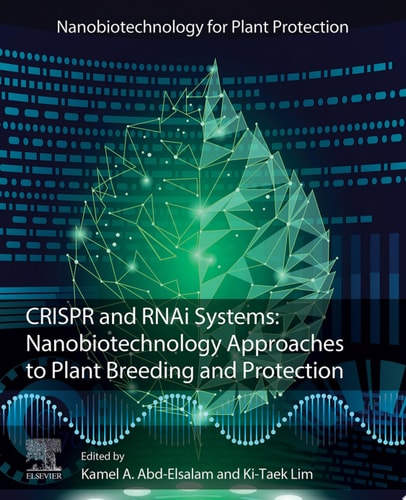
CRISPR and RNAi Systems
0
0
As an Amazon Associate and affiliate partner, Menrva Books earns from qualifying purchases. Learn more
Author Description
Plants are vulnerable to pathogens including fungi, bacteria, and viruses, which cause critical problems and deficits. Crop protection by plant breeding delivers a promising solution with no obvious effect on human health or the local ecosystem. Crop improvement has been the most powerful approach for producing unique crop cultivars since domestication occurred, making possible the main innovations in feeding the globe and community development. Genome editing is one of the genetic devices that can be implemented, and disease resistance is frequently cited as the most encouraging application of CRISPR/Cas9 technology in agriculture. Nanobiotechnology has harnessed the power of genome editing to develop agricultural crops. Nanosized DNA or RNA nanotechnology approaches could contribute to raising the stability and performance of CRISPR guide RNAs. This book brings together the latest research in these areas. CRISPR and RNAi Systems: Nanobiotechnology Approaches to Plant Breeding and Protection presents a complete understanding of the RNAi and CRISPR/Cas9 techniques for controlling mycotoxins, fighting plant nematodes, and detecting plant pathogens. CRISPR/Cas genome editing enables efficient targeted modification in most crops, thus promising to accelerate crop improvement. CRISPR/Cas9 can be used for management of plant insects, and various plant pathogens. The book is an important reference source for both plant scientists and environmental scientists who want to understand how nano biotechnologically based approaches are being used to create more efficient plant protection and plant breeding systems. Shows how nanotechnology is being used as the basis for new solutions for more efficient plant breeding and plant protection Outlines the major techniques and applications of both CRISPR and RNAi technologies Assesses the major challenges of escalating these technologies on a mass scale
Menrva's Summary
THE THESIS
This book investigates the application of nanobiotechnology, specifically CRISPR and RNAi systems, to enhance plant breeding and protection against pathogens. The author, Kamel A. Abd-Elsalam, synthesizes current research on these advanced genetic techniques, focusing on their role in developing disease-resistant crops. It details how nanosized DNA or RNA approaches can improve the stability and efficacy of CRISPR guide RNAs, offering solutions for mycotoxin control, nematode management, and pathogen detection. The work aims to provide a comprehensive understanding of these technologies for plant and environmental scientists seeking to implement more efficient agricultural systems.
THE SCOPE MAP
- Explores the vulnerability of plants to pathogens and the role of crop protection through breeding.
- Details the implementation of genome editing, particularly CRISPR/Cas9, for disease resistance in agriculture.
- Discusses the integration of nanobiotechnology with genome editing for agricultural advancements.
- Presents nanosized DNA or RNA nanotechnology approaches to enhance CRISPR guide RNAs' stability and performance.
- Covers RNAi and CRISPR/Cas9 techniques for controlling mycotoxins, fighting plant nematodes, and detecting plant pathogens.
- Explains how CRISPR/Cas genome editing facilitates targeted modification in crops to accelerate improvement.
- Addresses the application of CRISPR/Cas9 for managing plant insects and various plant pathogens.
- Assesses the challenges associated with scaling these technologies for mass application.
THE AUTHORITY PERSPECTIVE
This book serves as a critical reference for plant and environmental scientists by detailing the application of nanobiotechnology in plant breeding and protection. It outlines the major techniques and applications of CRISPR and RNAi technologies, emphasizing their role in creating more efficient agricultural systems. The work also addresses the significant challenges in scaling these advanced technologies for widespread adoption. The content suggests a focus on the practical implementation and future potential of these genetic tools in agriculture.
Page Count:
840
Publication Date:
2021-02-27
Publisher:
Elsevier S & T
ISBN-10:
0128219114
ISBN-13:
9780128219119
Science
Non-Fiction
Biotechnology
Genetics
Agriculture
Community Tags
Similar Books