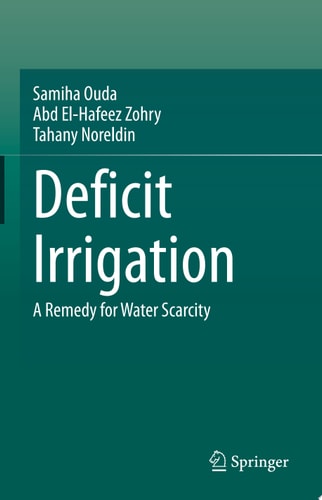
Deficit Irrigation
0
0
As an Amazon Associate and affiliate partner, Menrva Books earns from qualifying purchases. Learn more
Author Description
This book focuses on proving that deficit irrigation could play an important role in increasing food production in times of water scarcity. Although the application of deficit irrigation can involve loss in crop productivity, it still secures water to be use in cultivating more lands and producing more food. The following questions are discussed and the authors offer solutions to these problems: Will the production, on a national level, resulting from these new added areas compensate yield losses attained by application of deficit irrigation? Is it possible to use deficit irrigation practice to reduce the applied irrigation water to certain crops that have a surplus in their production, and direct this saved water to cultivate new areas with crops have low self-sufficiency ratios? Under climate change in 2030, would deficit irrigation practice have the same role it plays under the current conditions? This book will appeal to students and researchers involved with water scarcity and food security.
Menrva's Summary
THE THESIS
This book investigates the critical role of deficit irrigation in enhancing food production amidst escalating water scarcity. The authors, Abd El-Hafeez Zohry, Samiha Ouda, and Tahany Noreldin, explore how this practice, despite potential crop yield reductions, can secure water for cultivating more land and increasing overall food output. They address key questions regarding the national-level compensation for yield losses, the strategic redirection of water from surplus crops to deficit crops in low self-sufficiency areas, and the projected efficacy of deficit irrigation under climate change scenarios by 2030. This work is intended for students and researchers focused on water scarcity and food security.
THE SCOPE MAP
- Analysis of deficit irrigation's impact on food production during water scarcity.
- Discussion on compensating national yield losses with increased cultivated areas.
- Strategies for reallocating water from surplus crops to cultivate new areas of low self-sufficiency crops.
- Assessment of deficit irrigation practices under projected climate change conditions for 2030.
- Solutions and insights for students and researchers in water scarcity and food security fields.
THE AUTHORITY PERSPECTIVE
This book presents a focused examination of deficit irrigation as a strategy for food security in water-scarce regions. It addresses practical questions concerning national yield compensation and water resource reallocation, offering insights relevant to current agricultural challenges. The authors' analysis extends to the projected impact of climate change on these practices, providing a forward-looking perspective for researchers and students in the field.
Page Count:
196
Publication Date:
2020-01-22
Publisher:
Springer Nature
ISBN-10:
3030355861
ISBN-13:
9783030355869
Non-Fiction
Science
Agriculture
Food security
Irrigation
Climate Change
Community Tags
Similar Books














