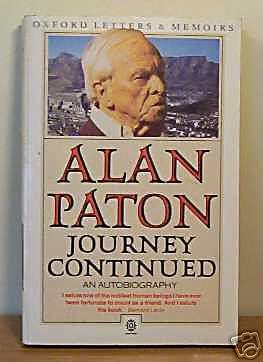
Journey Continued: An Autobiography
0
0
As an Amazon Associate and affiliate partner, Menrva Books earns from qualifying purchases. Learn more
Author Description
This second part of Alan Paton's autobiography begins in 1948, the year of publication of his best-selling book "Cry, the Beloved Country" and the rise to power of the Afrikaner Nationalists, whose oppressive and racist policies Paton was to fight as a writer, leader of the Liberal Party and devoted Christian. The book continues to focus on Paton's literary and political life. He tells of the success of "Cry, the Beloved Country", including the making of a musical and film based on it; his subsequent writing, including biographies of J.H.Hofmeyer and Archbishop Geoffrey Clayton, and the novel "Ah, But Your Land is Beautiful". His involvement with the controversial Liberal Party, which he led during the stormy time of the Sharpeville massacre and afterwards, is remembered, as is a visit to the USA in the last days of McCarthyism and legal segregation, and acquaintances including Nelson Mandela, Trevor Huddleston, Patrick Duncan, Robert Sobukwe and Chief Albert Lutuli. The story ends in 1968, when the Liberal Party disbanded to avoid obeying the government's order to separate into racial parties, but an epilogue brings the reader up to the present day. The first part of the autobiography is "Towards the Mountain", (OUP, 1981).
Menrva's Summary
THE THESIS
This autobiography examines the intersection of personal literary success and the escalating political struggle against apartheid in South Africa between 1948 and 1968. Alan Paton, a prominent South African writer and political activist, utilizes his personal records and historical memory to document his dual life as a novelist and the leader of the Liberal Party. He presents a framework that contrasts the international acclaim of his writing with the domestic reality of state-sanctioned racial oppression, detailing his efforts to maintain a multiracial political organization under increasingly hostile government mandates.
THE SCOPE MAP
What You Will Find
- A detailed account of the rise of the Afrikaner Nationalists and the implementation of apartheid policies.
- Insights into the internal operations and eventual dissolution of the Liberal Party of South Africa.
- Primary source reflections on interactions with figures such as Nelson Mandela, Trevor Huddleston, and Albert Lutuli.
Scope Limits
- The narrative primarily focuses on the years 1948 to 1968, with only a brief epilogue covering the subsequent period.
- The text prioritizes political and literary history over intimate personal or domestic details.
THE AUTHORITY PERSPECTIVE
Scholars and historians regard this work as a significant primary source for understanding the mid-twentieth-century South African political landscape. Readers frequently note the dense, reflective nature of the prose, which provides a clear window into the moral and strategic challenges faced by anti-apartheid activists during this era.
Page Count:
320
Publication Date:
1988-01-01
Publisher:
Oxford University Press
ISBN-10:
019219237X
ISBN-13:
9780192192370
Autobiography
History
Biography
African history
Literature
Community Tags
Other Editions(3)
Similar Books