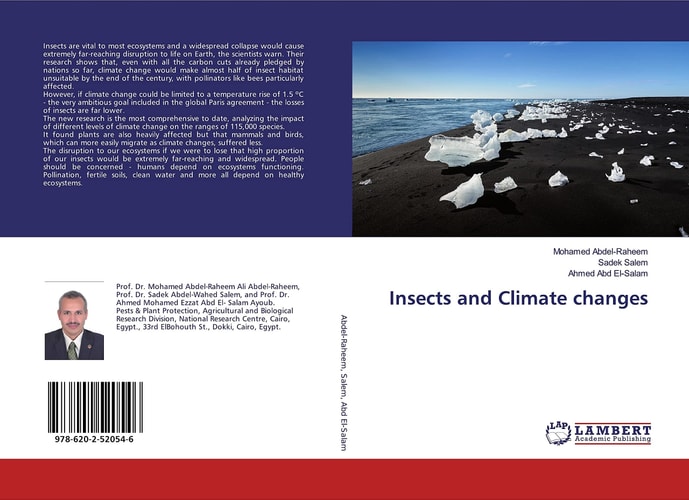
Insects and Climate Changes
0
0
As an Amazon Associate and affiliate partner, Menrva Books earns from qualifying purchases. Learn more
Author Description
Insects are vital to most ecosystems and a widespread collapse would cause extremely far-reaching disruption to life on Earth, the scientists warn. Their research shows that, even with all the carbon cuts already pledged by nations so far, climate change would make almost half of insect habitat unsuitable by the end of the century, with pollinators like bees particularly affected.However, if climate change could be limited to a temperature rise of 1.5 ºC - the very ambitious goal included in the global Paris agreement - the losses of insects are far lower.The new research is the most comprehensive to date, analyzing the impact of different levels of climate change on the ranges of 115,000 species. It found plants are also heavily affected but that mammals and birds, which can more easily migrate as climate changes, suffered less.The disruption to our ecosystems if we were to lose that high proportion of our insects would be extremely far-reaching and widespread. People should be concerned - humans depend on ecosystems functioning. Pollination, fertile soils, clean water and more all depend on healthy ecosystems.
Menrva's Summary
THE THESIS
Climate change poses a significant threat to insect populations, with potentially devastating consequences for global ecosystems. The research presented analyzes the impact of varying levels of climate change on the habitats of over 115,000 insect species, highlighting that even with current carbon cut pledges, nearly half of insect habitats could become unsuitable by the century's end. Pollinators, such as bees, are identified as particularly vulnerable. The study emphasizes that limiting global temperature rise to 1.5 ºC, as per the Paris Agreement, would substantially mitigate these losses, underscoring the critical link between human actions and ecosystem stability.
THE SCOPE MAP
- Analysis of the impact of different climate change scenarios on insect habitats.
- Focus on the vulnerability of pollinators like bees.
- Examination of the consequences of insect population collapse on ecosystems.
- Comparison of impacts on insects versus mammals and birds.
- Data derived from the study of 115,000 insect species.
- Discussion of the role of insects in pollination, soil fertility, and water quality.
- The critical importance of limiting global temperature rise to 1.5 ºC.
THE AUTHORITY PERSPECTIVE
This research highlights the critical role of insects in maintaining healthy ecosystems and warns of the widespread disruption that could occur due to climate change. The study provides a comprehensive analysis of how different levels of warming will affect insect habitats, with a particular focus on pollinators. It suggests that limiting global temperature rise to 1.5 ºC is crucial for minimizing insect population losses and preserving ecosystem functions essential for human well-being. The findings underscore the interconnectedness of climate, biodiversity, and human reliance on functioning natural systems.
Page Count:
112
Publication Date:
2020-04-01
Publisher:
LAP LAMBERT Academic Publishing
ISBN-10:
620252054X
ISBN-13:
9786202520546
Non-Fiction
Science
Conservation
Climate Change
Entomology
Ecology
Community Tags
Similar Books