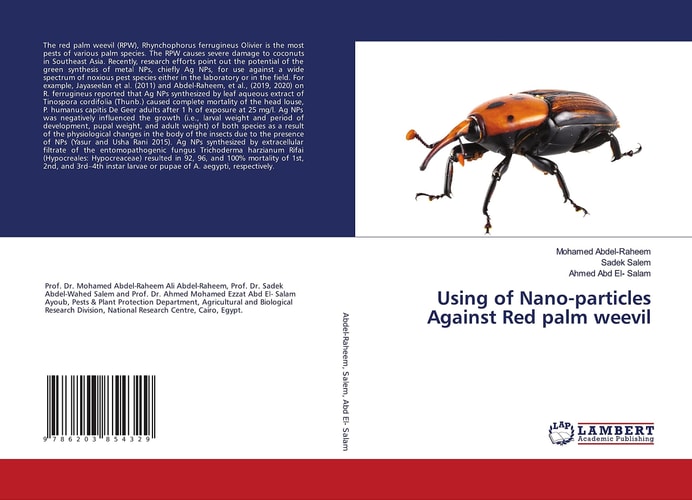
Using of Nano-particles Against Red Palm Weevil
0
0
As an Amazon Associate and affiliate partner, Menrva Books earns from qualifying purchases. Learn more
Author Description
The red palm weevil (RPW), Rhynchophorus ferrugineus Olivier is the most pests of various palm species. The RPW causes severe damage to coconuts in Southeast Asia. Recently, research efforts point out the potential of the green synthesis of metal NPs, chiefly Ag NPs, for use against a wide spectrum of noxious pest species either in the laboratory or in the field. For example, Jayaseelan et al. (2011) and Abdel-Raheem, et al., (2019, 2020) on R. ferrugineus reported that Ag NPs synthesized by leaf aqueous extract of Tinospora cordifolia (Thunb.) caused complete mortality of the head louse, P. humanus capitis De Geer adults after 1 h of exposure at 25 mg/l. Ag NPs was negatively influenced the growth (i.e., larval weight and period of development, pupal weight, and adult weight) of both species as a result of the physiological changes in the body of the insects due to the presence of NPs (Yasur and Usha Rani 2015). Ag NPs synthesized by extracellular filtrate of the entomopathogenic fungus Trichoderma harzianum Rifai (Hypocreales: Hypocreaceae) resulted in 92, 96, and 100% mortality of 1st, 2nd, and 3rd–4th instar larvae or pupae of A. aegypti, respectively.
Menrva's Summary
THE THESIS
This book investigates the efficacy of nanoparticles as a novel control agent against the red palm weevil (RPW), a significant pest of palm species. The research details the use of green synthesis of metal nanoparticles, particularly silver nanoparticles (Ag NPs), and their application against the RPW. It draws upon existing studies that demonstrate the effectiveness of Ag NPs in causing mortality and negatively influencing the growth and development of various insect species, including previous work on RPW.
THE SCOPE MAP
- Application of green synthesized metal nanoparticles (Ag NPs) against the red palm weevil (Rhynchophorus ferrugineus).
- Review of existing research on the use of Ag NPs for pest control, including studies on other insect species.
- Analysis of the impact of Ag NPs on insect growth, development, and mortality.
- Discussion of the physiological changes induced by nanoparticles in insects.
- Potential for Ag NPs as a laboratory and field control agent for RPW.
THE AUTHORITY PERSPECTIVE
The research presented in this book focuses on a specific application of nanotechnology within entomology, detailing the potential of silver nanoparticles as a control agent for the red palm weevil. The work synthesizes existing scientific literature to support its findings on nanoparticle efficacy. The approach suggests a detailed examination of experimental results and their implications for pest management strategies. The book is likely to be of interest to researchers and professionals in agricultural science, entomology, and nanotechnology.
Page Count:
136
Publication Date:
2021-04-22
Publisher:
LAP LAMBERT Academic Publishing
ISBN-10:
6203854328
ISBN-13:
9786203854329
Non-Fiction
Science
Nanotechnology
Pest Control
Agriculture
Entomology
Community Tags
Similar Books














