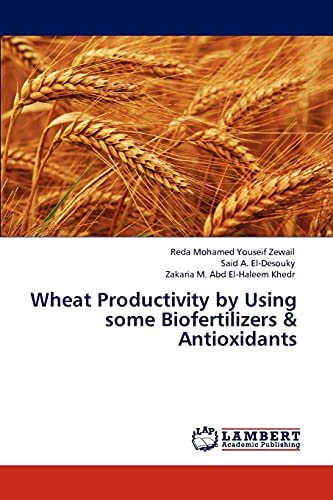
Wheat Productivity by Using Some Biofertilizers and Antioxidants
0
0
As an Amazon Associate and affiliate partner, Menrva Books earns from qualifying purchases. Learn more
Author Description
Wheat plant (Triticum aestivum. L) is the most important plant in family poaceae, from cereal crops because it has an international nutritional human feeding. The wheat plants considered one of the main cereal crops not only in Egypt but also all over the world. Biofertilizers one of the important management that assist to increase productivity and the reduction of using chemical fertilizers and alteration by biofertilizer treatments. Nitrogen, phosphorus and potassium are a major essential macronutrients for plant growth and development and soluble p and k fertilizers are commonly applied to replace removed minerals. When phosphate is added into soils as a fertilizer in relatively soluble and plant available forms, it is easily converted into insoluble complexes with calcium carbonate, aluminum silicate consequently, to achieve optimum crop yields either by soluble phosphate fertilizers or biofertilizers have to be applied at high rates which cause unmanageable excess of phosphate application and environmental and economic problems.
Menrva's Summary
THE THESIS
This study investigates methods to enhance wheat productivity by examining the combined effects of biofertilizers and antioxidants. The research addresses the critical role of wheat as a global food staple and the challenges associated with traditional chemical fertilizer use, such as nutrient fixation and environmental concerns. It explores biofertilizers as a sustainable alternative to increase crop yields and reduce reliance on chemical inputs, particularly for essential macronutrients like nitrogen, phosphorus, and potassium. The work aims to present findings on how specific treatments can optimize nutrient availability and plant growth.
THE SCOPE MAP
- An examination of wheat (Triticum aestivum. L) as a primary global food crop.
- Analysis of biofertilizers as a strategy to improve agricultural productivity and reduce chemical fertilizer dependency.
- Discussion on the fixation of phosphorus in soil and its implications for plant nutrient uptake.
- Evaluation of the impact of specific biofertilizer and antioxidant treatments on wheat growth and yield.
THE AUTHORITY PERSPECTIVE
The research presented in this paper focuses on agricultural science, specifically crop productivity. The study's approach, which combines biofertilizers and antioxidants, suggests an investigation into sustainable farming practices and nutrient management in wheat cultivation. The detailed examination of nutrient fixation and the potential of alternative inputs indicates a focus on practical applications for farmers and agronomists seeking to optimize yields while mitigating environmental impacts. The work is likely to be of interest to researchers and practitioners in agronomy and plant science.
Page Count:
232
Publication Date:
2012-01-01
Publisher:
Lap Lambert Academic Publishing GmbH KG
ISBN-10:
3847371215
ISBN-13:
9783847371212
Science
Non-Fiction
Soil Science
Fertilizers
Plant Science
Agronomy
Agriculture
Community Tags
Similar Books














