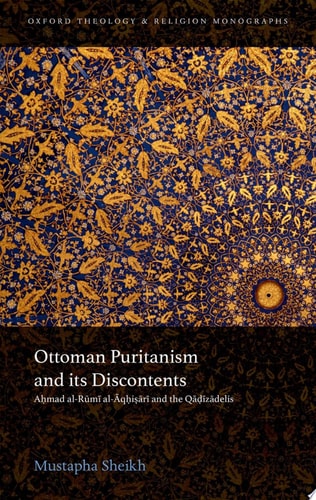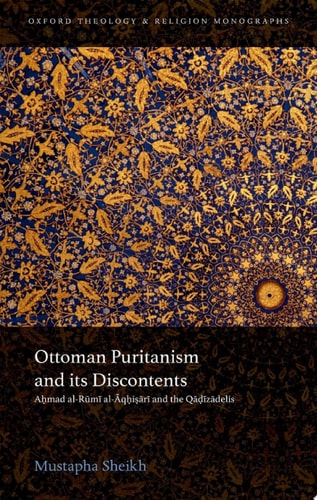
Ottoman Puritanism and its Discontents: Ahmad al-Rumi al-Aqhisari and the Qadizadelis
0
0
As an Amazon Associate and affiliate partner, Menrva Books earns from qualifying purchases. Learn more
Author Description
This book is about the emergence of a new activist Sufism in the Muslim world from the sixteenth century onwards, which emphasized personal responsibility for putting God’s guidance into practice. It focuses specifically on developments at the centre of the Ottoman Empire, but also considers both how they might have been influenced by the wider connections and engagements of learned and holy men and how their influence might have been spread from the Ottoman Empire to South Asia in particular. The immediate focus is on the Qadizadeli movement which flourished in Istanbul from the 1620s to the 1680s and which inveighed against corrupt scholars and heterodox Sufis. The book aims by studying the relationship between Ahmad al-Rumi al-Aqhisari’s magisterial Majalis al-abrar and Qadizadeli beliefs to place both author and the movement in an Ottoman, Hanafi, and Sufi milieu. In so doing, it breaks new ground, both in bringing to light al-Aqhisari’s writings, and methodologically, in Ottoman studies at least, in employing line-by-line textual comparisons to ascertain the borrowings and influences linking al-Aqhisari to medieval Islamic thinkers such as Ahmad b. Taymiyya and Ibn Qayyim al-Jawziyya, as well as to several near-contemporaries. Most significantly, the book finally puts to rest the strict dichotomy between Qadizadeli reformism and Sufism, a dichotomy that with too few exceptions continues to be the mainstay of the existing literature.
Menrva's Summary
THE THESIS
This work investigates the ideological origins and theological framework of the Qadizadeli movement within the seventeenth-century Ottoman Empire. Mustapha Sheikh, a scholar of Islamic theology, utilizes a rigorous comparative textual analysis of Ahmad al-Rumi al-Aqhisari’s Majalis al-abrar to challenge established academic narratives. He argues that the Qadizadeli movement was not a simple anti-Sufi reaction but a complex reformist development deeply rooted in Hanafi and Sufi traditions, influenced by medieval thinkers such as Ibn Taymiyya.
THE SCOPE MAP
What You Will Find
- An analysis of the Qadizadeli movement in Istanbul from the 1620s to the 1680s.
- A detailed examination of Ahmad al-Rumi al-Aqhisari’s intellectual contributions.
- Line-by-line textual comparisons linking Ottoman reformism to earlier Islamic scholarship.
- Discussion of the transmission of ideas between the Ottoman Empire and South Asia.
Scope Limits
- The study does not provide a comprehensive history of all Sufi orders in the Ottoman Empire.
- It does not cover the political history of the Ottoman state beyond its intersection with religious reform movements.
THE AUTHORITY PERSPECTIVE
Experts recognize this text as a significant contribution to Ottoman studies for its methodological rigor in textual comparison. Scholars frequently note that the book successfully dismantles the binary opposition between reformism and Sufism that has long dominated the field.
Page Count:
201
Publication Date:
2016-01-01
Publisher:
OUP Oxford
ISBN-10:
0192508105
ISBN-13:
9780192508102
History
Religion
Islamic Studies
Sufism
Theology
Ottoman Empire
Community Tags
Similar Books