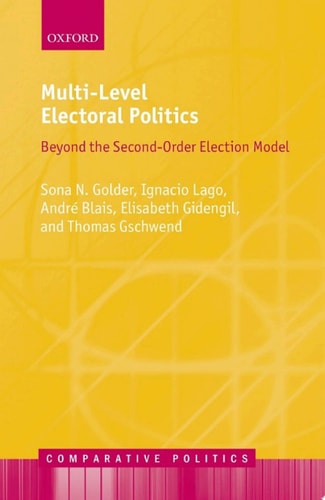
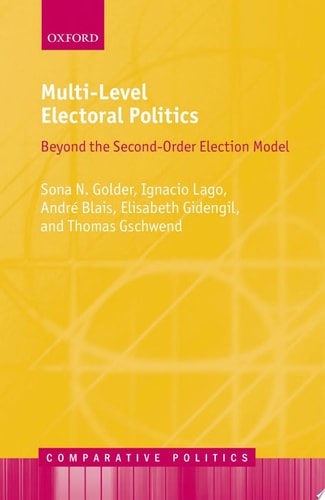
Multi-Level Electoral Politics: Beyond the Second-Order Election Model
0
0
As an Amazon Associate and affiliate partner, Menrva Books earns from qualifying purchases. Learn more
Author Description
National-level elections receive more attention from scholars and the media than elections at other levels, even though in many European countries the importance of both regional and European levels of government has grown in recent years. The growing importance of multiple electoral arenas suggests that scholars should be cautious about examining single levels in isolation. Taking the multilevel structure of electoral politics seriously requires a re-examination of how the incentives created by electoral institutions affect the behaviour of voters and party elites. The standard approach to analysing multilevel elections is the second-order election (SOE) model, in which national elections are considered to be first-order elections while other elections are second order. However, this model does not provide micro mechanisms that determine how elections in one arena affect those in another, or explain variations in individual voting behaviour. The objective of this book is to explain how party and voter behaviour in a given election is affected by the existence of multiple electoral arenas. It provides original qualitative and quantitative data to examine European, national, and subnational elections in France, Germany, and Spain from 2011-2015. The volume examines party mobilization efforts across multiple electoral arenas, as well as decisions by individual voters with respect to turnout, strategic voting, and accountability. This book provides the first systematic analysis of multilevel electoral politics at three different levels across multiple countries. Comparative Politics is a series for researchers, teachers, and students of political science that deals with contemporary government and politics. Global in scope, books in the series are characterised by a stress on comparative analysis and strong methodological rigour. The series is published in association with the European Consortium for Political Research. For more information visit: www.ecprnet.eu.
Menrva's Summary
THE THESIS
This book investigates how the existence of multiple electoral arenas—national, regional, and European—shapes the behavior of voters and party elites, challenging the traditional second-order election model. The authors, a team of prominent political scientists, utilize a comparative framework to move beyond the limitations of viewing elections in isolation. By analyzing the micro-mechanisms that link different electoral levels, they provide a more nuanced understanding of how institutional incentives influence political outcomes in contemporary democracies.
THE SCOPE MAP
What You Will Find
- Comparative analysis of electoral politics across France, Germany, and Spain from 2011-2015.
- Examination of party mobilization strategies in multi-level systems.
- Empirical assessment of individual voter behavior regarding turnout, strategic voting, and accountability.
Scope Limits
- The analysis is restricted to the specific time frame of 2011-2015 and the three aforementioned European countries.
- The study does not address non-European electoral systems or historical periods outside the specified range.
THE AUTHORITY PERSPECTIVE
Experts recognize this volume as a significant contribution to the study of multi-level governance and electoral behavior. Scholars frequently cite the work for its methodological rigor and its successful attempt to provide a systematic alternative to the long-standing second-order election model.
Page Count:
223
Publication Date:
2017-01-01
Publisher:
OUP Oxford
ISBN-10:
0192509187
ISBN-13:
9780192509185
Electoral Systems
Comparative Politics
Community Tags
Similar Books






Reader Comments
Share Your Thoughts
No comments yet. Be the first to share your thoughts!