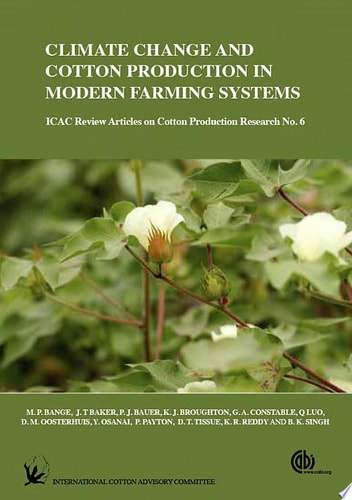
Climate Change and Cotton Production in Modern Farming Systems
0
0
As an Amazon Associate and affiliate partner, Menrva Books earns from qualifying purchases. Learn more
Author Description
Throughout the world cotton is broadly adapted to growing in temperate, sub-tropical, and tropical environments, but growth may be challenged by future climate change. Production may be directly affected by changes in crop photosynthesis and water use due to rising CO2 and changes in regional temperature patterns. Indirect effects may result from a range of government regulations aimed at climate change mitigation. While there is certainty that future climate change will impact cotton production systems; there will be opportunities to adapt. This review begins to provide details for the formation of robust frameworks to evaluate the impact of projected climatic changes, highlight the risks and opportunities with adaptation, and details the approaches for investment in research. Ultimately, it is a multi-faceted systems-based approach that combines all elements of the cropping system that will provide the best insurance to harness the change that is occurring, and best allow cotton industries worldwide to adapt. Given that there will be no single solution for all of the challenges raised by climate change and variability, the best adaptation strategy for industry will be to develop more resilient systems. Early implementation of adaptation strategies, particularly in regard to enhancing resilience, has the potential to significantly reduce the negative impacts of climate change now and in the future.
Menrva's Summary
THE THESIS
This review investigates the multifaceted impacts of projected climate change on global cotton production and explores adaptive strategies for resilient farming systems. The authors, a team of distinguished researchers in agronomy and climate science, examine how rising CO2 levels and altered temperature patterns directly influence crop photosynthesis and water use. They also consider the indirect effects of climate change mitigation regulations, highlighting both the risks and opportunities for adaptation within the cotton industry. The core argument emphasizes a systems-based approach, combining all elements of the cropping system to build resilience and mitigate negative impacts.
THE SCOPE MAP
- Analysis of direct impacts of rising CO2 and temperature changes on cotton photosynthesis and water use.
- Evaluation of indirect impacts stemming from climate change mitigation regulations.
- Identification of risks and opportunities associated with adapting cotton production to climate change.
- Frameworks for assessing projected climatic changes on cotton farming systems.
- Approaches for investment in research to support adaptation strategies.
- Emphasis on a multi-faceted, systems-based approach for comprehensive adaptation.
- Discussion of developing more resilient cotton production systems as a key adaptation strategy.
- Consideration of early implementation of adaptation strategies for present and future impact reduction.
THE AUTHORITY PERSPECTIVE
This comprehensive review synthesizes current knowledge on the critical intersection of climate change and cotton production. It provides a detailed examination of the challenges and potential adaptive pathways for one of the world's most significant agricultural commodities. The authors advocate for a proactive, systems-level approach to research and investment, underscoring the necessity of building resilient farming systems to navigate an evolving climate.
Page Count:
71
Publication Date:
2016-03-02
Publisher:
CABI
ISBN-10:
1780648901
ISBN-13:
9781780648903
Science
Non-Fiction
Agronomy
Climate Change
Agriculture
Crop Science
Community Tags
Similar Books















Reader Comments
Share Your Thoughts
No comments yet. Be the first to share your thoughts!