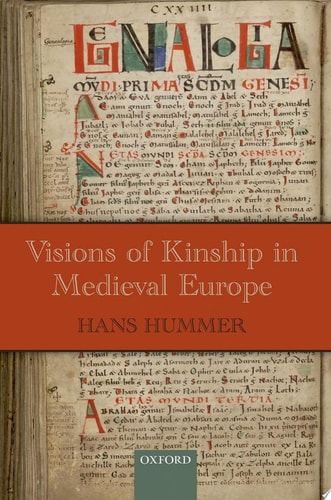
Visions of Kinship in Medieval Europe
0
0
As an Amazon Associate and affiliate partner, Menrva Books earns from qualifying purchases. Learn more
Author Description
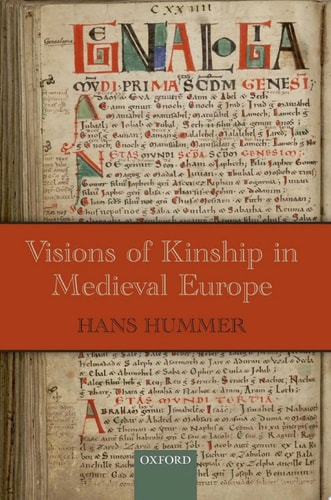
What meaning did human kinship possess in a world regulated by Biblical time, committed to the primacy of spiritual relationships, and bound by the sinews of divine love? In the process of exploring this question, Hans Hummer offers a searching re-examination of kinship in Europe between late Roman times and the high middle ages, the period bridging Europe's primitive past and its modern future. Visions of Kinship in Medieval Europe critiques the modernist and Western bio-genealogical and functionalist assumptions that have shaped kinship studies since their inception in the nineteenth century, when Biblical time collapsed and kinship became a signifier of the essential secularity of history and a method for conceptualizing a deep prehistory guided by autogenous human impulses. Hummer argues that this understanding of kinship is fundamentally antagonistic to medieval sentiments and is responsible for the frustrations researchers have encountered as they have tried to identify the famously elusive kin groups of medieval Europe. He delineates an alternative ethnographic approach inspired by recent anthropological work that privileges indigenous expressions of kinship and the interpretive potential of native ontologies. This study reveals that kinship in the middle ages was not biological, primitive, or a regulator of social mechanisms; nor was it traceable by bio-genealogical connections. In the Middle Ages, kinship signified a sociality that flowed from convictions about the divine source of all things and which wove together families, institutions, and divinities into an expansive eschatological vision animated by 'the most righteous principle of love'.
Menrva's Summary
THE THESIS
This study investigates how medieval European kinship functioned as a social construct rooted in divine love and eschatological vision rather than biological or functionalist frameworks. Hans Hummer, a scholar of medieval history, challenges the nineteenth-century secular assumptions that have historically dominated kinship studies. By utilizing anthropological methodologies that prioritize indigenous medieval ontologies, Hummer argues that modern researchers have failed to identify medieval kin groups because they applied anachronistic bio-genealogical models to a society defined by spiritual rather than secular connections.
THE SCOPE MAP
What You Will Find
- An examination of kinship structures from late Roman times through the high Middle Ages.
- A critique of modernist, functionalist, and bio-genealogical historiography.
- An ethnographic framework centered on native medieval ontologies and spiritual sociality.
Scope Limits
- The study does not focus on modern or post-medieval kinship developments.
- It excludes analysis of kinship outside the specific context of Christian medieval Europe.
THE AUTHORITY PERSPECTIVE
Scholars recognize this work as a significant intervention in medieval historiography that forces a reconsideration of how historians interpret social structures. Readers frequently note the academic density of the prose and the author's rigorous application of anthropological theory to historical data.
Page Count:
392
Publication Date:
2018-01-01
Publisher:
OUP Oxford
ISBN-10:
0192518305
ISBN-13:
9780192518309
History
European History
Anthropology
Cultural History
Sociology
Europe