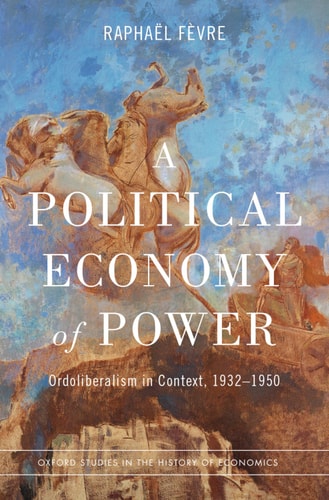
A Political Economy of Power: Ordoliberalism in Context, 1932-1950
0
0
As an Amazon Associate and affiliate partner, Menrva Books earns from qualifying purchases. Learn more
Author Description
The first English analysis of German ordoliberalism from the perspective of both intellectual history and history of economic thought In comparison with Keynesianism, monetarism, or other economic paradigms of the twentieth century, ordoliberalism has been generally neglected. However, after first emerging in Germany during interwar years, ordoliberalism is now at the center of the ongoing debates about the foundations, the present governance, and the future prospects of the European Union. In A Political Economy of Power, Raphaël Fèvre retraces the intellectual history of ordoliberalism, focusing on the works of its main representatives Walter Eucken and Wilhelm Röpke, together with the contributions of Franz Böhm, Alexander Rüstow, Leonhard Miksch, and Friedrich Lutz. Fèvre provides a clear and comprehensive definition of ordoliberalism, describes in detail its principles, and explains how ordoliberalism came to heavily influence German post-war reconstruction despite its emergence during the Nazi period. He also investigates the reasons for its success in West Germany in the immediate aftermath of the war, and its lasting influence through a partial transformation to a contemporary form of neoliberal orthodoxy. A Political Economy of Power provides a contextualized and interdisciplinary study of ordoliberalism-one of the most influential intellectual projects of the second half of the twentieth century in Europe.
Menrva's Summary
THE THESIS
How did ordoliberalism emerge as a dominant economic paradigm in post-war Germany despite its origins during the interwar and Nazi periods? Raphaël Fèvre, an expert in the history of economic thought, examines the intellectual development of ordoliberalism by analyzing the primary texts and contributions of key figures such as Walter Eucken, Wilhelm Röpke, and Franz Böhm. The book utilizes a rigorous historical framework to trace the evolution of these ideas from their initial formulation in the 1930s to their implementation in West German reconstruction. By situating these economic theories within their specific political and social contexts, Fèvre argues that ordoliberalism provided a necessary structural foundation for the modern European Union.
THE SCOPE MAP
What You Will Find
- A detailed historical analysis of German ordoliberalism between 1932 and 1950.
- Examination of the intellectual contributions of Walter Eucken, Wilhelm Röpke, Franz Böhm, Alexander Rüstow, Leonhard Miksch, and Friedrich Lutz.
- A comprehensive definition of ordoliberal principles and their application to post-war economic reconstruction.
- An investigation into the transition of ordoliberalism into a contemporary form of neoliberal orthodoxy.
THE AUTHORITY PERSPECTIVE
Experts recognize this work as a foundational text for understanding the intellectual roots of German economic policy. Readers frequently note the academic density of the prose, which provides a thorough and necessary examination of a previously neglected economic paradigm.
Page Count:
616
Publication Date:
2021-01-01
Publisher:
Oxford University Press
ISBN-10:
0197607829
ISBN-13:
9780197607824
History
Economics
Economic History
European History
Economics history
Special Topics
Modern History
Intellectual History
Public Policy
Community Tags
Other Editions(2)
Similar Books