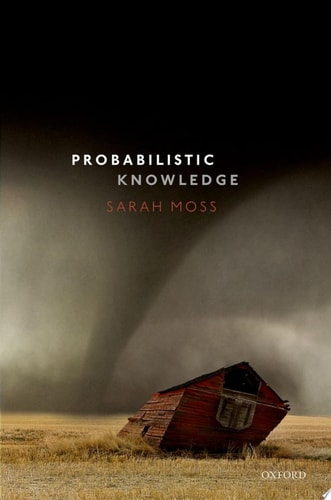
Probabilistic Knowledge
0
0
As an Amazon Associate and affiliate partner, Menrva Books earns from qualifying purchases. Learn more
Author Description
Traditional Philosophical Discussions Of Knowledge Have Focused On The Epistemic Status Of Full Beliefs. Sarah Moss Argues That In Addition To Full Beliefs, Credences Can Constitute Knowledge. For Instance, Your 0.4 Credence That It Is Raining Outside Can Constitute Knowledge, In Just The Same Way That Your Full Beliefs Can. In Addition, You Can Know That It Might Be Raining, And That If It Is Raining Then It Is Probably Cloudy, Where This Knowledge Is Not Knowledge Of Propositions, But Of Probabilistic Contents. The Notion Of Probabilistic Content Introduced In This Book Plays A Central Role Not Only In Epistemology, But In The Philosophy Of Mind And Language As Well. Just As Tradition Holds That You Believe And Assert Propositions, You Can Believe And Assert Probabilistic Contents. Accepting That We Can Believe, Assert, And Know Probabilistic Contents Has Significant Consequences For Many Philosophical Debates, Including Debates About The Relationship Between Full Belief And Credence, The Semantics Of Epistemic Modals And Conditionals, The Contents Of Perceptual Experience, Peer Disagreement, Pragmatic Encroachment, Perceptual Dogmatism, And Transformative Experience. In Addition, Accepting Probabilistic Knowledge Can Help Us Discredit Negative Evaluations Of Female Speech, Explain Why Merely Statistical Evidence Is Insufficient For Legal Proof, And Identify Epistemic Norms Violated By Acts Of Racial Profiling. Hence The Central Theses Of This Book Not Only Help Us Better Understand The Nature Of Our Own Mental States, But Also Help Us Better Understand The Nature Of Our Responsibilities To Each Other.
Menrva's Summary
THE THESIS
This book investigates whether credences—degrees of belief—can constitute knowledge in the same manner as traditional full beliefs. Sarah Moss, a professor of philosophy, utilizes formal epistemology and linguistic analysis to argue that probabilistic contents are objects of belief, assertion, and knowledge. By expanding the scope of what counts as knowledge, the author provides a framework to address complex issues ranging from the semantics of epistemic modals to social and legal concerns regarding evidence and bias.
THE SCOPE MAP
What You Will Find
- A formal theory of probabilistic content as an alternative to propositional content
- Analysis of the relationship between full belief and credence
- Application of probabilistic knowledge to legal proof and racial profiling
- Examination of epistemic modals and conditionals
Scope Limits
- The text does not provide a comprehensive history of traditional epistemology
- The work focuses primarily on analytic philosophical frameworks rather than empirical psychological studies
THE AUTHORITY PERSPECTIVE
Experts recognize this work as a significant contribution to contemporary formal epistemology that challenges long-standing assumptions about the nature of belief. Readers frequently note the academic density of the prose, which requires a strong background in logic and analytic philosophy to fully engage with the arguments presented.
Page Count:
224
Publication Date:
2018-01-01
Publisher:
Oxford University Press
ISBN-10:
0192510584
ISBN-13:
9780192510587
Philosophy
Conditionals logic
Philosophy of
Logic
Certainty
Knowledge Theory
Probabilities
Epistemology
Assertion Linguistics
Community Tags
Other Editions(2)

Similar Books