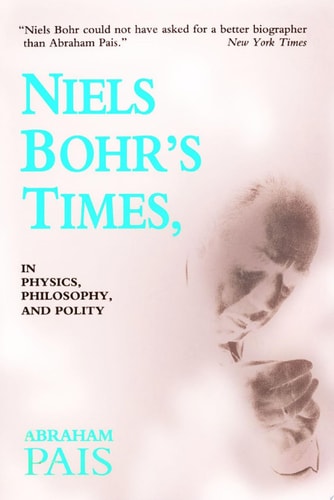
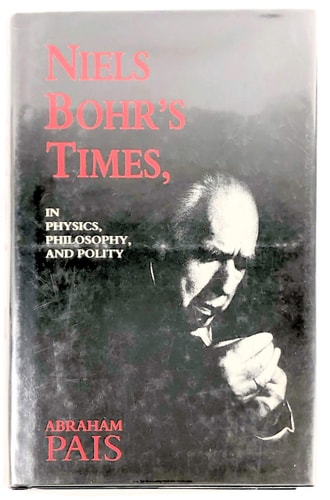
Niels Bohr's Times: In Physics, Philosophy, and Polity
0
0
As an Amazon Associate and affiliate partner, Menrva Books earns from qualifying purchases. Learn more
Author Description
Niel Bohr's life spans times of revolutionary change, in science and in its impact on society. Along with Einstein, Bohr can be considered as this century's major driving force behind the new mathematical and philosophical descriptions of the atom, the nucleus, and all that resulted from them. Abraham Pais, the acclaimed biographer of Einstein, traces Bohr's progress from his well-to-do origins in late nineteenth century Denmark to his central position in the world political scene, particularly because of the development of nuclear weapons during the Second World War. Bohr was one of the great enabling figures in modern science, not only because of his direct involvement in the application of quantum theory to our understanding of the structure of the atom, but also because he gathered around him in Copenhagen most of the brightest young minds of the period. Figures like Pauli, Dirac, and Heisenberg, all required Bohr's imprimatur, to varying degrees, before they considered their work ready for widespread consumption. He had a complex relationship with Einstein, both in terms of their fundamental disagreements and their profound though distant mutual respect. He owed an important debt to his mentor, Rutherford - a man who came to serve, in many ways, as his role model. Pais describes the state of physics before Bohr and considers his legacy, both theoretical and practical. But more than this, he captures the essence of Bohr, the intensely private family man who, despite appalling personal tragedy, became one of the best-loved cultural figures of recent times.
Menrva's Summary
THE THESIS
How did Niels Bohr shape the trajectory of modern physics while navigating the shifting political and philosophical landscapes of the twentieth century? Abraham Pais, a distinguished physicist and biographer, utilizes his deep familiarity with the scientific community to examine Bohr's intellectual development and his influence on the quantum revolution. The text argues that Bohr's significance extends beyond his specific contributions to atomic theory, positioning him as a central architect of the collaborative scientific culture that defined the era. By integrating personal correspondence, historical records, and technical analysis, Pais constructs a comprehensive portrait of a man who bridged the gap between abstract theoretical inquiry and global political responsibility.
THE SCOPE MAP
What You Will Find
- Detailed analysis of the development of quantum theory and atomic structure.
- Historical documentation of the Copenhagen school and its influence on physicists like Pauli, Dirac, and Heisenberg.
- Examination of Bohr's political involvement during the Second World War and the development of nuclear weapons.
- Insights into the intellectual debates between Bohr and Albert Einstein.
Scope Limits
- The text does not provide a comprehensive technical textbook on quantum mechanics, focusing instead on the historical and biographical context of the discoveries.
- It does not offer an exhaustive account of all political events in Denmark, limiting its scope to those directly impacting Bohr's life and work.
THE AUTHORITY PERSPECTIVE
Experts and historians of science frequently cite this work as a definitive biographical account due to the author's unique position as a contemporary of the subjects involved. Readers often note the academic density of the prose, which requires a foundational understanding of physics to fully appreciate the nuances of the scientific discussions presented.
Page Count:
1088
Publication Date:
1991-01-01
Publisher:
OUP Oxford
ISBN-10:
0192522302
ISBN-13:
9780192522306
Biography
20th Century
English & College Success
English
Biography Autobiography
Physics
Philosophy of
Science History
Community Tags
Other Editions(3)
Similar Books