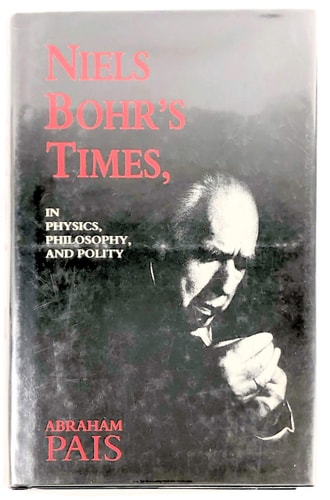
Niels Bohr's Times: In Physics, Philosophy, and Polity
0
0
As an Amazon Associate and affiliate partner, Menrva Books earns from qualifying purchases. Learn more
Author Description
Abraham Pais's life of Albert Einstein was one of the finest scientific biographies ever written. When it first appeared in 1982, Christian Science Monitor called it "an extraordinary biography of an extraordinary man," and Timothy Ferris, in The New York Times Book Review, said it was "the biography of Einstein he himself would have liked best," adding that "it is a work against which future scientific biographies will be measured." As a respected physicist himself, Pais was the first biographer to give Einstein's thinking its full due, yet despite the occasional high level of science needed to discuss Einstein's ideas, the book was a national bestseller. Indeed, it was one of The New York Times's Best Books of the Year, and the winner of the 1983 American Book Award for Science.Now Pais turns to Niels Bohr, to illuminate the life and thought of another giant of 20th-century physics. Bohr was the first to understand how atoms were put together, he played a major role in shaping the theory of the atomic nucleus, he decoded the atomic spectrum of hydrogen, an achievement which marks him as the founder of the quantum dynamics of atoms, and his concept of complementarity (which provides the philosophical underpinning for quantum theory) qualifies him as one of the twentieth century's greatest philosophers. Pais covers all of these achievements with sophistication and clarity, but he also reveals the many other facets of the man. Perhaps most important, he shows that Bohr was not only a great scientist, but also a great nurturer of young scientific talent, acting as father figure extraordinaire for several generations of physicists. Bohr's Institute of Theoretical Physics, which he founded in Copenhagen and for which he tirelessly raised funds, was the world's leading center for physics all through the 1920s and 1930s, the birthplace of Heisenberg's papers on the uncertainty relations, Dirac's first paper on quantum electrodynamics, and other pivotal works.
Menrva's Summary
THE THESIS
This work investigates the life and intellectual contributions of Niels Bohr, seeking to define his dual legacy as a foundational architect of quantum mechanics and a pivotal figure in the development of 20th-century scientific institutions. Abraham Pais, a distinguished physicist who worked alongside the giants of the field, utilizes his deep technical expertise to bridge the gap between complex theoretical physics and biographical narrative. By examining Bohr's personal correspondence, institutional records, and scientific papers, Pais constructs a comprehensive framework that situates Bohr's philosophical concept of complementarity within the broader political and social context of his era.
THE SCOPE MAP
What You Will Find
- Detailed analysis of Bohr's contributions to atomic structure and quantum dynamics.
- Exploration of the philosophical implications of the complementarity principle.
- Historical documentation regarding the founding and operation of the Institute of Theoretical Physics in Copenhagen.
- Examination of Bohr's role as a mentor and institutional leader for multiple generations of physicists.
THE AUTHORITY PERSPECTIVE
Experts and historians of science frequently cite this work as a definitive account of Bohr's life, noting the author's unique ability to balance rigorous scientific explanation with humanistic insight. Readers often remark on the density of the technical discussions, which serve as a testament to the author's deep immersion in the subject matter.
Page Count:
604
Publication Date:
1991-10-03
Publisher:
Oxford University Press
ISBN-10:
0198520492
ISBN-13:
9780198520498
Biography
Science
Physics
Community Tags
Other Editions(3)
Similar Books



Reader Comments
Share Your Thoughts
No comments yet. Be the first to share your thoughts!