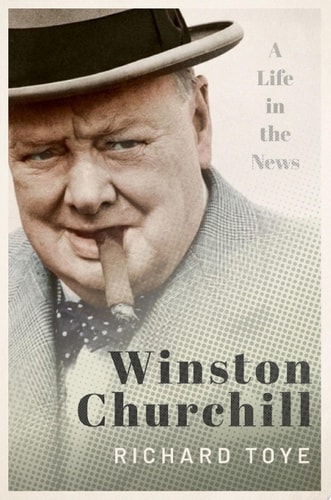
Winston Churchill: A Life in the News
0
0
As an Amazon Associate and affiliate partner, Menrva Books earns from qualifying purchases. Learn more
Author Description
Before Winston Churchill made history, he made news. To a great extent, the news made him too. If it was his own efforts that made him a hero, it was the media that made him a celebrity - and it has been considerably responsible for perpetuating his memory and shaping his reputation in the years since his death. Churchill first made his name via writing and journalism in the years before 1900, the money he earned helping to support his political career (at a time when MPs did not get salaries). Journalistic activities were also important to him later, as he struggled in the interwar years to find the wherewithal to run and maintain Chartwell, his country house in Kent. Moreover, not only was journalism an important aspect of Churchill's political persona, but he himself was a news-obsessive throughout his life. The story of Churchill and the news is, on one level, a tale of tight deadlines, off-the-record briefings and smoke-filled newsrooms, of wartime summits that were turned into stage-managed global media events, and of often tense interactions with journalists and powerful press proprietors, such as Lords Northcliffe, Rothermere, and Beaverbrook. Uncovering the symbiotic relationship between Churchill's political life and his media life, and the ways in which these were connected to his personal life, Richard Toye asks if there was a 'public Churchill' whose image was at odds with the behind-the-scenes reality, or whether, in fact, his private and public selves became seamlessly blended as he adjusted to living in the constant glare of the media spotlight. On a wider level, this is also the story of a rapidly evolving media and news culture in the first half of the twentieth century, and of what the contemporary reporting of Churchill's life (including by himself) can tell us about the development of this culture, over a period spanning from the Victorian era through to the space age.
Menrva's Summary
THE THESIS
This book investigates the symbiotic relationship between Winston Churchill’s political career and his lifelong engagement with the media. Richard Toye, a professor of modern history, utilizes archival research, personal correspondence, and contemporary press reports to examine how Churchill leveraged journalism to fund his political ambitions and cultivate his public image. The author argues that Churchill was not merely a subject of the news but an active participant in its creation, effectively blending his private and public personas to navigate the evolving media landscape of the twentieth century.
THE SCOPE MAP
What You Will Find
- Analysis of Churchill’s early career as a war correspondent and writer.
- Examination of his interactions with influential press proprietors like Lords Northcliffe, Rothermere, and Beaverbrook.
- Exploration of how media coverage shaped his reputation during wartime and the interwar years.
Scope Limits
- The book does not provide a comprehensive chronological biography of Churchill’s entire life.
- It does not focus on his military strategy or policy decisions outside of their relationship to media representation.
THE AUTHORITY PERSPECTIVE
Historians and media scholars recognize this work as a significant contribution to understanding the intersection of political power and press influence in the early twentieth century. Readers frequently note the meticulous research and the author's ability to contextualize Churchill’s media savvy within the broader evolution of global news culture.
Page Count:
386
Publication Date:
2020-01-01
Publisher:
OUP Oxford
ISBN-10:
0192526030
ISBN-13:
9780192526038
Biography
History
Public opinion
Press
20th Century
Great Britain
Journalism
Media Studies
Modern History
Press coverage
Community Tags
Similar Books