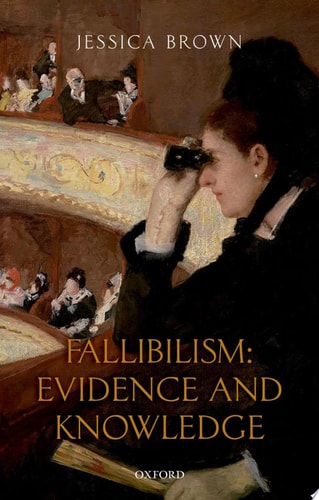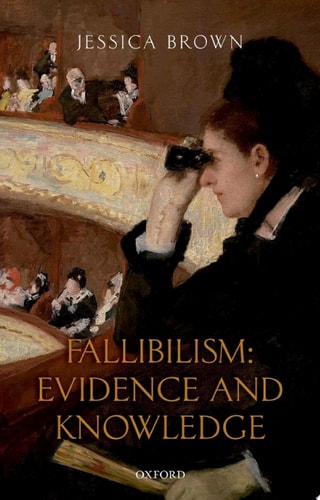
Fallibilism: Evidence and Knowledge
0
0
As an Amazon Associate and affiliate partner, Menrva Books earns from qualifying purchases. Learn more
Author Description
What strength of evidence is required for knowledge? Ordinarily, we often claim to know something on the basis of evidence which doesn't guarantee its truth. For instance, one might claim to know that one sees a crow on the basis of visual experience even though having that experience does not guarantee that there is a crow (it might be a rook, or one might be dreaming). As a result, those wanting to avoid philosophical scepticism have standardly embraced "fallibilism": one can know a proposition on the basis of evidence that supports it even if the evidence doesn't guarantee its truth. Despite this, there's been a persistent temptation to endorse "infallibilism", according to which knowledge requires evidence that guarantees truth. For doesn't it sound contradictory to simultaneously claim to know and admit the possibility of error? Infallibilism is undergoing a contemporary renaissance. Furthermore, recent infallibilists make the surprising claim that they can avoid scepticism. Jessica Brown presents a fresh examination of the debate between these two positions. She argues that infallibilists can avoid scepticism only at the cost of problematic commitments concerning evidence and evidential support. Further, she argues that alleged objections to fallibilism are not compelling. She concludes that we should be fallibilists. In doing so, she discusses the nature of evidence, evidential support, justification, blamelessness, closure for knowledge, defeat, epistemic akrasia, practical reasoning, concessive knowledge attributions, and the threshold problem.
Menrva's Summary
THE THESIS
This book investigates the core question of whether knowledge requires evidence that guarantees truth or if fallibilism provides a more robust framework for understanding human belief. Jessica Brown, a prominent philosopher, utilizes contemporary debates in epistemology to challenge the resurgence of infallibilism. She systematically evaluates the logical costs of infallibilist positions and defends the fallibilist stance against common objections, ultimately arguing that fallibilism is the superior account of knowledge.
THE SCOPE MAP
What You Will Find
- Analysis of the relationship between evidence, justification, and truth
- Examination of epistemic closure and the threshold problem
- Discussion of epistemic akrasia and practical reasoning
Scope Limits
- The text does not provide a comprehensive history of skepticism
- It does not address non-analytic or continental philosophical perspectives on knowledge
THE AUTHORITY PERSPECTIVE
Experts recognize this work as a significant contribution to contemporary analytic epistemology that clarifies the tension between fallibilism and infallibilism. Readers frequently note the technical density of the prose, making it most suitable for advanced students and professional philosophers.
Page Count:
224
Publication Date:
2018-01-01
Publisher:
OUP Oxford
ISBN-10:
0192521926
ISBN-13:
9780192521927
Non-Fiction
Philosophy
Logic
Epistemology
Knowledge Theory
Evidence