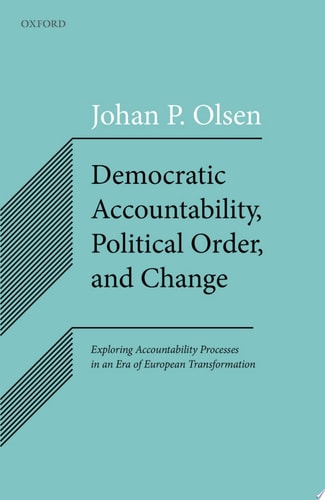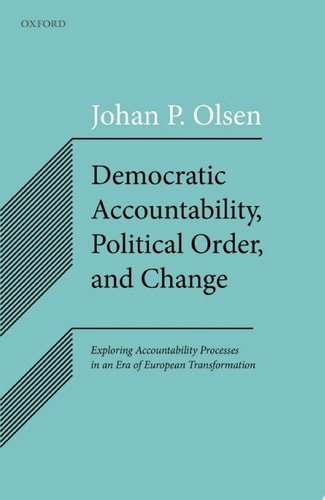
Democratic Accountability, Political Order, and Change: Exploring Accountability Processes in an Era of European Transformation
0
0
As an Amazon Associate and affiliate partner, Menrva Books earns from qualifying purchases. Learn more
Author Description
Ongoing transformations of the political organization of Europe, where both the nation-state and the European Union are challenged, make it possible to explore phenomena that are difficult to see in stable periods. An upsurge in accountability-demands, where political leaders are required to explain and justify what they are doing, is one such phenomenon. Mainstream approaches to democratic accountability, assuming settled principal-agent relations may give insight into the routines of institutional accountability. This book argues that it is not enough to analyze how accountability processes contribute to routinized maintenance of an established order within relatively stable, simple, and well-known situations. We need to understand accountability in eras of institutional confusion and contestation and in dynamic, complex, and unknown situations. First, variations in the relations between democratic accountability and political association, organization, and agency are endogenous to politics. Second, accountability processes take place within both settled and unsettled orders. They can be both order-maintaining and order-transforming. Third, accountability involves sense-making as well as decision-making. Fourth, accountability may involve mass mobilization or go on largely unnoticed by the public. Fifth, accountability processes may or may not foster new ideas about political order, government, and the role of rank-and-file citizens in political life. They may or may not affect what democracy will mean and imply in the future. The aim of this book is twofold: to contribute to the theorization of democratic accountability and to discuss what accountability processes tell us about political order and orderly change in general.
Menrva's Summary
THE THESIS
This book investigates how accountability processes function as mechanisms for both maintaining and transforming political order during periods of institutional instability and European change. Johan P. Olsen, a prominent scholar in institutional theory, utilizes the current challenges facing the European Union and the nation-state to critique mainstream principal-agent models. He argues that accountability must be understood as a dynamic process of sense-making and contestation rather than merely a routine administrative function.
THE SCOPE MAP
What You Will Find
- Analysis of accountability within unsettled political orders
- Theoretical framework linking accountability to political agency and organization
- Examination of the dual role of accountability in order-maintenance and order-transformation
Scope Limits
- Does not provide a comprehensive history of the European Union
- Does not offer prescriptive policy recommendations for specific political crises
THE AUTHORITY PERSPECTIVE
Scholars in the field of political science recognize this work as a significant contribution to institutional theory, particularly for its focus on the complexity of democratic processes. Readers frequently note the academic density of the prose, which is intended for an audience familiar with political science discourse and organizational theory.
Page Count:
222
Publication Date:
2017-01-01
Publisher:
OUP Oxford
ISBN-10:
0192520873
ISBN-13:
9780192520876
Public Finance
Governance
Institutional Theory
European
Democracy
Community Tags
Similar Books