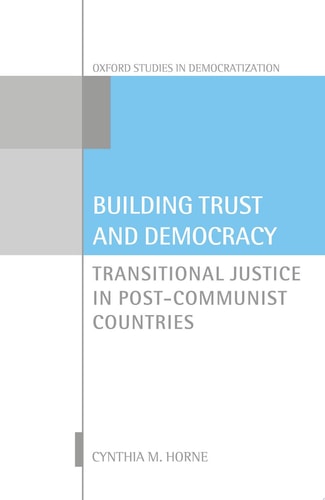
Building Trust and Democracy: Transitional Justice in Post-Communist Countries
0
0
As an Amazon Associate and affiliate partner, Menrva Books earns from qualifying purchases. Learn more
Author Description
This volume explores the effects of transitional justice measures on trust-building and democratization across twelve countries in Central and Eastern Europe and parts of the Former Soviet Union over the period 1989-2012.The author argues that transitional justice measures have a differentiated impact on political and social trust building, supporting some aspects of political trust and undermining other aspects of social trust. Moreover, the structure, scope, timing, and implementation of transitional justice measures condition outcomes. More expansive and compulsory institutional change mechanisms register the largest effects, with limited and voluntary change mechanisms having a diminished effect, and more informal and largely symbolic measures having the most attenuated effect. These differentiated and conditional effects are also evident with respect to transition goals like supporting democratic consolidation and reducing corruption, since these goals respond differently to the mixtures of institutional and symbolic reforms found in transitional justice programs.The author develops an original transitional justice typology focusing on the degree to which lustration measures, public disclosure procedures, and file access provisions are expansive and compulsory, limited and voluntary, largely informal and symbolic, or actively rejected. Using this typology, the author categorizes post-communist countries according to the scope and implementation of their measures in order to test hypotheses linking trust building and transitional justice across twelve cases in the region. The resulting new datasets allow for a quantitative examination of the relationship between different types of transitional justice programs and a range of possible state building and societal reconciliation goals, including political trust building, social trust building, democratization, the strengthening of civil society, the promotion of government effectiveness, and the reduction of corruption.
Menrva's Summary
THE THESIS
This volume investigates how varying transitional justice measures influence the development of political and social trust within post-communist states. Cynthia M. Horne, an expert in political science and democratization, utilizes a comparative analysis of twelve countries across Central and Eastern Europe and the former Soviet Union from 1989 to 2012. She argues that the specific structure, timing, and implementation of these justice programs create differentiated outcomes, where expansive, compulsory mechanisms yield significantly different results for democratic consolidation than informal or symbolic measures.
THE SCOPE MAP
What You Will Find
- A comparative analysis of twelve post-communist countries between 1989 and 2012.
- An original typology categorizing lustration, public disclosure, and file access policies.
- Quantitative datasets examining the correlation between justice programs and state-building goals.
- Empirical evidence regarding the impact of institutional reforms on corruption and civil society.
THE AUTHORITY PERSPECTIVE
Scholars and political analysts identify this work as a rigorous contribution to the study of transitional justice and institutional design. Readers frequently note the academic density of the prose and the systematic nature of the comparative methodology employed throughout the text.
Page Count:
400
Publication Date:
2017-07-04
Publisher:
Oxford University Press
ISBN-10:
0198793324
ISBN-13:
9780198793328
History
European
Politics & Government
Sociology
Democracy
International relations
Trust
Community Tags
Other Editions(2)
Similar Books










Reader Comments
Share Your Thoughts
No comments yet. Be the first to share your thoughts!