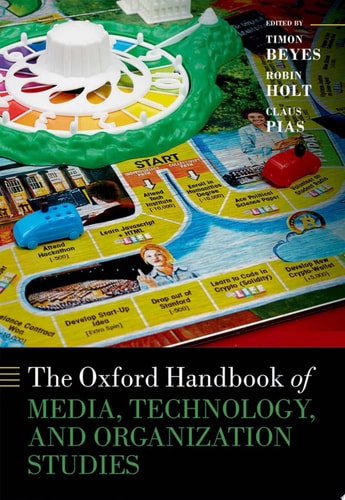
The Oxford Handbook of Media, Technology, and Organization Studies
0
0
As an Amazon Associate and affiliate partner, Menrva Books earns from qualifying purchases. Learn more
Author Description
Our Most Basic Relationship With The World Is One Of Technological Mediation. Nowadays Our Available Tools Are Digital, And Increasingly What Counts In Economic, Social, And Cultural Life Is What Can Be Digitally Stored, Distributed, Replayed, Augmented, And Switched. Yet The Digital Remains Very Much Materially Configured, And Though It Now Permeates Nearly All Human Life It Has Not Eclipsed All Older Technologies. This Handbook Is Grounded In An Understanding That Our Technologically Mediated Condition Is A Condition Of Organization. It Maps And Theorizes The Largely Unchartered Territory Of Media, Technology, And Organization Studies. Written By Scholars Of Organization And Theorists Of Media And Technology, The Chapters Focus On Specific, And Specifically Mediating, Objects That Shape The Practices, Processes, And Effects Of Organization. It Is In This Spirit That Each Chapter Focuses On A Specific Technological Object, Such As The Battery, Clock, High Heels, Container, Or Smartphone, Asking The Question, How Does This Object Or Process Organize? In Staying With The Object The Chapters Remain Committed To The Everyday, Empirical World, Rather Than Being Confined To Established Disciplinary Concerns And Theoretical Developments. As The First Sustained And Systematic Interrogation Of The Relation Between Technologies, Media, And Organization, This Handbook Consolidates, Deepens, And Further Develops The Empirics And Concepts Required To Make Sense Of The Material Forces Of Organization.
Menrva's Summary
THE THESIS
How do specific technological objects and processes actively shape, mediate, and organize human social and economic life? The editors, Claus Pias, Robin Holt, and Timon Beyes, curate a collection of contributions from scholars in organization studies and media theory to examine the material conditions of our technologically mediated world. The text argues that organization is not merely a social construct but is fundamentally tied to the physical and digital tools that permeate everyday life, proposing a framework that prioritizes the study of specific objects to understand broader organizational forces.
THE SCOPE MAP
What You Will Find
- Theoretical frameworks linking media studies with organizational theory
- Case studies focusing on specific objects such as batteries, clocks, high heels, containers, and smartphones
- Analysis of how material objects influence organizational practices, processes, and effects
- Interdisciplinary perspectives bridging sociology, management, and media history
Scope Limits
- Does not provide a comprehensive history of all organizational technologies
- Avoids abstract, purely theoretical discourse in favor of object-oriented empirical analysis
THE AUTHORITY PERSPECTIVE
Experts identify this handbook as a foundational text for scholars seeking to bridge the gap between media theory and organizational studies. Readers frequently note the academic density of the prose, which is intended for researchers and advanced students in the social sciences.
Page Count:
560
Publication Date:
2019-01-01
Publisher:
Oxford University Press
ISBN-10:
0192537954
ISBN-13:
9780192537959
Communication Studies
Technology
Sociology
Management Theory
Media Studies
Community Tags
Other Editions(3)

Similar Books
Reader Comments
Share Your Thoughts
No comments yet. Be the first to share your thoughts!